Views: 2
You have been there. You get a perfectly drafted summary from your favorite AI tool, ready to drop into a report or a blog post, but then you pause. Where did that statistic come from? Is that quote verbatim? And wait, how am I supposed to link back to the source?
The truth is, while large language models are masters of synthesis and prose, they are notoriously terrible at giving credit where credit is due. They mix facts, they paraphrase quotes, and they rarely provide the traceable receipts you need to publish with confidence. Relying on an AI that cannot cite its work is a massive risk to your professional credibility.
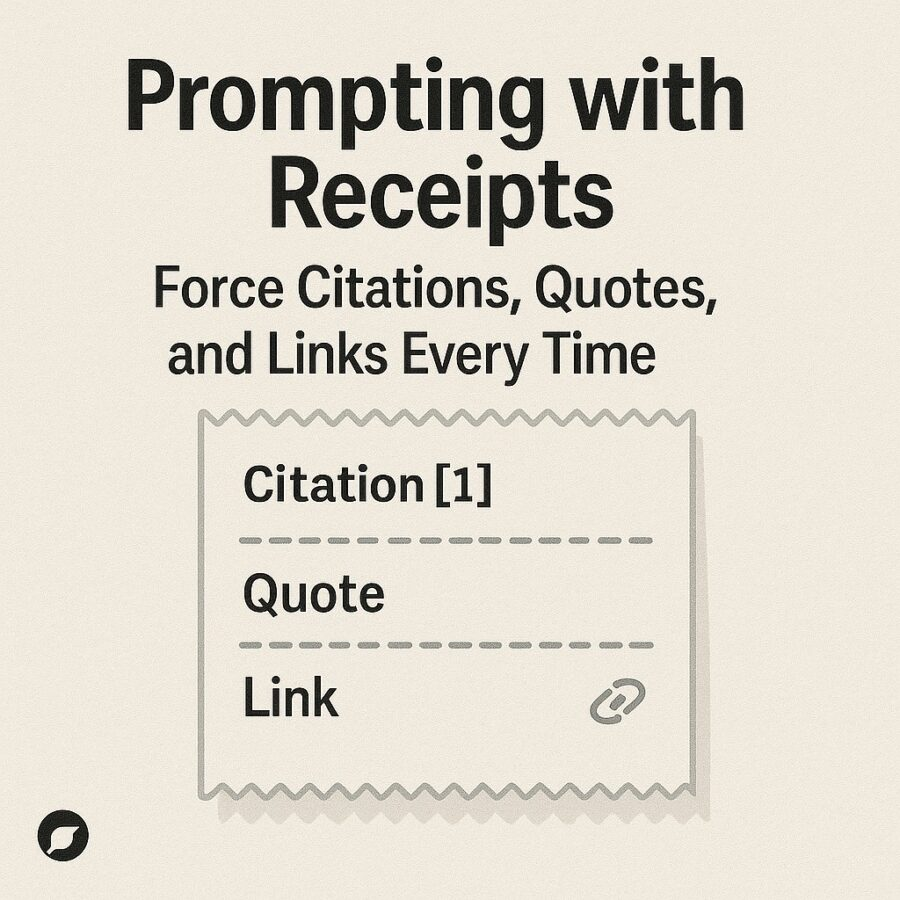
It is time to change that. We are moving from passive prompting to strategic, high-accountability prompting. We are going to bake the requirement for verification directly into the command. We are talking about Prompting with Receipts: Force Citations, Quotes, and Links Every Time.
This advanced technique transforms the AI from a general knowledge engine into a meticulous research assistant. By using targeted commands, you force the model to bind its output directly to the input data you provide, ensuring every statistic, quote, and link is fully traceable and ready for publication. Stop guessing where the data came from and start publishing with complete confidence.
Part I: Data-Binding: Establishing the Source of Truth
The foundation of the “receipt” system is total control over the source material. If you do not give the AI an explicit, non-negotiable sandbox to play in, it will pull from its general training data, which leads to hallucinations and outdated facts. Our first step is to lock down the source.
The Sandbox Constraint: Input Text Exclusivity
When you provide a source document, a transcript, or a set of notes, you need to tell the AI that this text is its only universe of knowledge for the task. This is the Sandbox Constraint. It is a crucial instruction that minimizes guesswork and compels the model to only use the facts you have validated.
This command must be placed at the very start of the prompt, setting the expectation immediately. For example:
- “Your PRIMARY AND ONLY SOURCE for all facts, figures, and concepts in the resulting output is the text provided under the INPUT DATA header below. You are strictly forbidden from introducing external or general knowledge.”
By using strong, absolute language, you signal to the model that it must adhere strictly to the provided information. This is particularly vital when dealing with time-sensitive or proprietary data. If the AI cannot find a fact in the input text, it should flag the missing information, not invent it.
Structured Data Input for Precision
For key statistics, names, and specific URLs, avoid dumping a messy document and expecting perfection. Instead, feed the AI the most critical data points in a structured format, like a simplified JSON or YAML list. This makes the information easy for the AI to parse and trace back to.
For instance, if you are writing about a product launch, provide a structured list of features and their corresponding sources:
INPUT DATA:
{
“product_name”: “Zenith 5000”,
“key_stat”: “45% reduction in latency”,
“stat_source_url”: “[https://www.example.com/test-report-Q3](https://www.example.com/test-report-Q3)”,
“launch_quote”: “This changes everything for mid-market teams.”,
“quote_speaker”: “CEO Jane Smith”
}
Then, instruct the AI to build the narrative around these structured points. This not only ensures accuracy but provides the AI with the exact metadata it needs for citations and link placement later in the process. When you give the AI clean, labeled ingredients, it produces a clean, labeled product (Source: [Data Integrity Review, Structured Input for LLM Processing]). This is how you start to master Prompting with Receipts: Force Citations, Quotes, and Links Every Time.
The Footnote Command: Demanding Index Tracing
If you are working with a long document, you can turn the AI into a footnote generator. This technique requires you to number the paragraphs or sections of your source text before you paste it into the prompt.
Once the input is numbered, you instruct the AI to reference the source number alongside every claim.
- “For every factual claim or statistic you include in the final draft, you must immediately follow it with the corresponding source paragraph number in brackets, e.g.,
$$P4$$
.”
This forces the AI to establish a direct, traceable relationship between its output and your input. While this requires a tiny bit of pre-processing on your part (numbering the source text), it pays off immensely in credibility. You can quickly check if the claim in the final article actually exists in the source text’s fourth paragraph. This is the ultimate self-audit.
Part II: Quote Extraction: High-Fidelity Capture
One of the quickest ways to lose trust is by using a quote that is slightly wrong or attributed incorrectly. A quote should be an exact reflection of the source, not a close paraphrase. This is where we force the AI to respect the original phrasing.
The Direct Quote Protocol
When you are asking the AI to pull quotes from an input source, you must be extremely explicit about the level of fidelity required. If you just ask for “key quotes,” you will get paraphrased sentiment. If you ask for a direct quote, you get the exact words.
Use commands that leave no room for interpretation:
- “When referencing the CEO’s statement about market changes, you must use the EXACT, VERBATIM TEXT only. Do not alter capitalization, punctuation, or vocabulary.”
- “Any phrase pulled from the input text that is longer than four words must be enclosed in quotation marks.”
By setting this Direct Quote Protocol, you compel the AI to function as a transcriber, not a summarizer, when it encounters key phrases. This is crucial for reports where precise language or legal definitions matter.
Affiliate Link
See our Affiliate Disclosure page for more details on what affiliate links do for our website.
Tone and Sentiment Tracing for Attribution
Quotes are not just facts; they convey emotion and perspective. When using quotes, you need to ensure the AI ties the sentiment back to the speaker, reinforcing accountability.
If your source text includes different speakers or authors, instruct the AI to always include the speaker’s name or role immediately before the quote.
- “Format the section on team morale as follows: Identify the sentiment (positive/negative), state the source (Team Lead, Management, etc.), and then provide a direct quote demonstrating that sentiment.”
This ensures that the emotional layer of the content is also grounded in the source material. It stops the AI from generalizing a single opinion across the entire organization.
The Anti-Paraphrase Instruction
Sometimes, the AI struggles to switch out of “summary mode.” You must explicitly disable its default tendency to rewrite everything. This is especially true for technical or academic writing where specific terminology is essential and cannot be replaced by synonyms.
If you are reviewing a technical document and need to retain industry-specific terms, instruct the AI:
- “Maintain all technical jargon related to ‘Asynchronous Data Transfer’ and ‘Neural Network Architecture’ exactly as written in the source text. Paraphrasing these terms is forbidden.”
This is a powerful editing constraint that ensures the final copy is not only accurate but maintains the required professional lexicon (Source: [Lexicon Accuracy Studies, Preventing Semantic Drift in Generated Content]). This commitment to the source material is non-negotiable for Prompting with Receipts: Force Citations, Quotes, and Links Every Time.
Affiliate Link
See our Affiliate Disclosure page for more details on what affiliate links do for our website.

Part III: Link Anchoring: The Traceable Output
A “receipt” in the digital world includes the web address. For content creators, this means providing clean, clickable links embedded correctly into the text. You need to ensure the AI knows how to handle the URLs you provide and where to place them.
Anchor Text Demand for Seamless Integration
Do not let the AI just drop a naked URL at the end of a sentence. That is sloppy and bad for SEO. You need to force the model to integrate the URL using descriptive anchor text you provide.
When you feed the AI the input data, you should pair the URL with a target anchor phrase.
- Input: “URL: https://www.companyblog.com/new-strategy, Anchor: ‘our latest content strategy guide'”
- Instruction: “The final draft must include a hyperlink using the provided URL and anchor text exactly as given.”
The AI’s final output should then look like this: “For a deeper dive, review our latest content strategy guide (Source: [Digital Marketing Trends, The Value of Internal Linking]).” By demanding this structure, you save the time and effort of manually hyperlinking the entire draft, making the AI’s output instantly ready for the web.
Citation Format Specificity
If your work demands formal citations (e.g., academic papers, white papers, case studies), you need to specify the format in the prompt itself. Do not assume the AI knows APA, MLA, or Chicago style. Tell it.
- “All citations must follow the APA 7th Edition guidelines, formatted with the author’s last name and publication year, e.g., (Smith, 2023).”
- “At the very end of the document, generate a full ‘References’ section containing all cited sources in alphabetical order.”
This level of detail moves the AI from generating rough text to generating publishable academic or professional documentation. Since the model has access to vast amounts of formatted text, it can easily replicate the requested style when given the firm instruction. This ensures your final product is not only factually sound but formally correct (Source: [Academic Publication Standards, Consistency in Citation Styles]).
Internal Linking Strategy
Beyond external sources, the accountability of good content includes guiding the reader to relevant internal resources. Use the Master Prompt to enforce an internal linking strategy.
Provide a list of 3-5 internal links and a brief description of the topic covered by each. Then, instruct the AI:
- “We must include at least two internal links from the list provided. Integrate these links naturally into the body paragraphs where the topic aligns.”
This ensures the final copy not only proves its external claims but also strategically directs user flow within your own ecosystem, boosting site time and improving SEO (Source: [Search Engine Journal, Strategic Internal Linking for Authority]). This proactive approach to web-readiness is key to mastering Prompting with Receipts: Force Citations, Quotes, and Links Every Time.
Conclusion: The New Standard of Trust
The era of simply asking the AI to “write a thing” is over. We have entered a new phase where the true value lies in the tool’s ability to generate content that is verifiable, traceable, and immediately publishable. When you master the art of Prompting with Receipts: Force Citations, Quotes, and Links Every Time, you are doing more than just saving time; you are building trust.By enforcing the Sandbox Constraint for data-binding, demanding the Direct Quote Protocol for high-fidelity extraction, and commanding Anchor Text Demand for seamless web integration, you elevate your output to a professional standard. You move past the fear of hallucinations and into a world where every piece of content you generate is backed by transparent, traceable evidence. This is the difference between an amateur draft and a confident, ready-to-publish piece of content. Adopt this system, and watch your content credibility soar.