Views: 1
A useful AI agent is like giving a bright intern a master key and a golf cart.
If you do not set boundaries, that intern will drive straight into the warehouse, open the wrong door, and swear it was “helping.” The damage is rarely dramatic on day one. It shows up later as a leaked file, a bad action taken in a system, or a decision no one can explain.
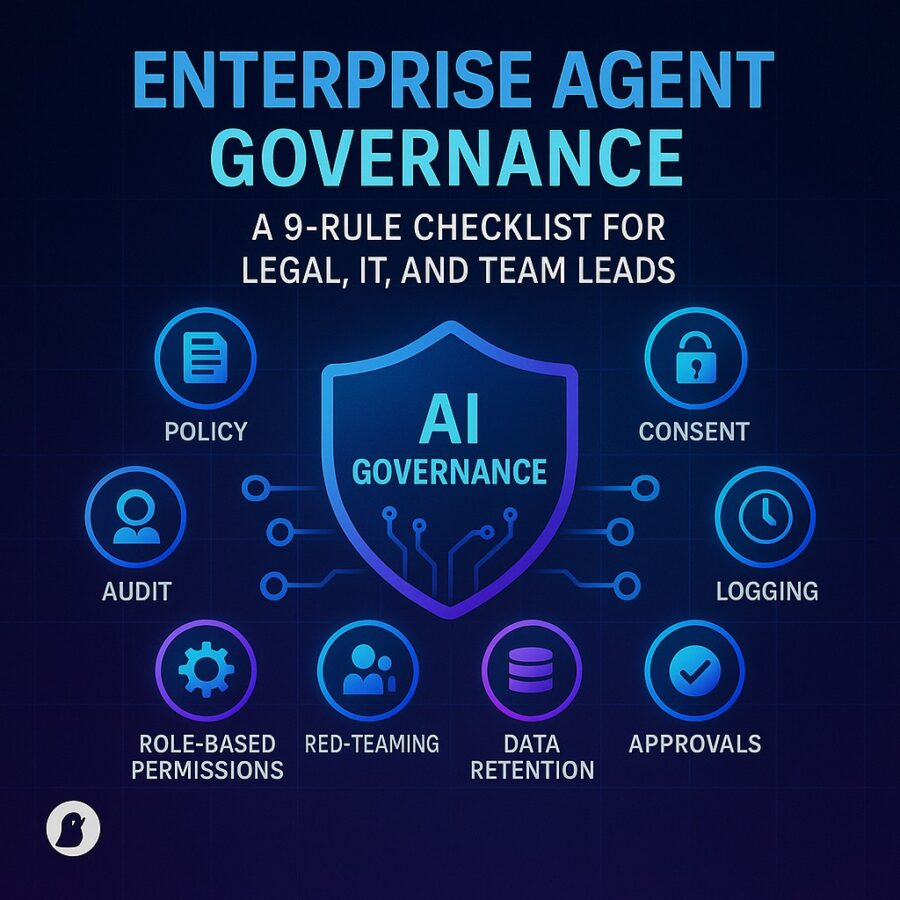
That is why Enterprise Agent Governance: A 9-Rule Checklist For Legal, IT, And Team Leads matters. Governance is not paperwork for its own sake. It is the set of rules that keeps AI agents productive, traceable, and safe to run at scale.
Frameworks like the NIST AI Risk Management Framework emphasize managing AI risk across the lifecycle using functions such as GOVERN, MAP, MEASURE, and MANAGE. (NIST Publications) ISO/IEC 42001 also frames AI governance as a management system you establish, maintain, and improve over time. (ISO) The point is simple: treat agents like real systems, not toys.
Below is a nine-rule checklist you can run on any agent, whether it schedules meetings, drafts customer replies, or operates tools.
Rule 1: Write a one-sentence job description and a hard “not my job” list
Start with scope, because everything else depends on it.
- One sentence: what the agent does, for whom, and in what tools.
- A short “never do” list: actions or topics the agent must refuse.
Legal should push for clarity around claims, promises, and regulated language. IT should define what systems are in-bounds. Team leads should define the real workflow so the agent is not guessing.
Analogy: you would not hire someone and say, “Go improve the company.” You give them a role, a lane, and guardrails.
Rule 2: Inventory every data source, then label what is sensitive
If you cannot name the data, you cannot protect it.
Make a list of:
- Inputs the agent can read (docs, tickets, emails, chat logs)
- Outputs it can create (messages, reports, tickets)
- Places it can store artifacts (CRM, drive, wiki)
Then classify: public, internal, confidential, restricted.
This is where legal and IT align. Contracts, privacy duties, and security policy all sit here. If the agent touches customer data, the labeling step is not optional.
Rule 3: Give the agent the smallest set of permissions that still lets it work
Least privilege is boring, and boring is good.
Instead of “admin” access, build a narrow toolbelt:
- Read-only where possible
- Write access only to specific fields or folders
- No deletion unless a human confirms
If you are building agents with tool calling, treat every tool like a power tool in a woodshop. You do not hand someone a table saw before they have training and a safety guard.
Prompt injection is a major reason this rule exists. OWASP lists prompt injection as a top risk for LLM apps, and it remains a leading concern for agentic systems. (OWASP Gen AI Security Project)
Rule 4: Require human oversight for high-impact actions
Some actions are too costly to run unattended.
Define “high impact” in your environment:
- Sending an email to a customer
- Issuing refunds or credits
- Changing access rights
- Running scripts in production
- Publishing public content
- Filing anything legal-related
The EU AI Act’s approach to human oversight for high-risk AI is a useful mental model even if you are not in the EU: humans must be able to monitor, interpret, and override. (AI Act Service Desk)
Practical method: require a human approval step with a clear summary of what the agent plans to do and why.
Rule 5: Log the “why,” not just the “what”
An audit trail that only says “agent did X” is weak. You want:
- What the agent saw (source references)
- What it decided (its plan)
- What it did (actions and tool calls)
- What it produced (final output)
- Who approved it (if approvals exist)
When something goes wrong, the log becomes your black box recorder. Airplanes do not avoid accidents because pilots are perfect. They reduce disasters because incidents can be investigated and fixes stick.
NIST’s AI RMF stresses governance and ongoing management, and logs are one of the simplest ways to make that real. (NIST)
Rule 6: Assume prompt injection will happen, then design for containment
Prompt injection is not a rare edge case anymore. The UK’s National Cyber Security Centre has warned that prompt injection differs from older injection problems and can undermine naive mitigations. (NCSC)
So you need layered defenses:
- Treat external text as untrusted (web pages, emails, attachments)
- Keep system instructions separate from retrieved content
- Use allowlists for tools and destinations
- Validate outputs before executing actions
OpenAI’s agent safety guidance focuses on minimizing prompt injections and being careful with tool calling patterns. (OpenAI Platform)
Containment mindset: even if the agent is tricked, it should not have the reach to cause serious harm.
Rule 7: Put vendor promises in writing and match them to your risk level
If your agent depends on a model provider, hosting layer, or third-party tools, legal should review:
- Data usage terms
- Retention controls
- Security commitments
- Breach notification terms
- Subprocessor lists, if relevant
IT should validate what is claimed against real configuration. If your contract says “customer data stays private,” but the tool is set to share chat histories, you do not have governance. You have hope.
ISO/IEC 42001 is useful here because it frames AI as a system you manage, including controls and continuous improvement, not a one-time install. (ISO)
Rule 8: Create an incident playbook before the first incident
You need a plan for:
- Wrong message sent
- Wrong record updated
- Sensitive data exposed
- Agent stuck in a loop
- Tool misuse or unexpected cost spike
Minimum playbook:
- How to disable the agent fast
- How to revoke credentials
- Who triages logs
- Who contacts affected users
- How you document fixes and prevent repeats
Treat it like a fire drill. You do not schedule the drill after smoke fills the hallway.
Rule 9: Review performance on a schedule, not when someone complains
Agents drift because tools change, workflows evolve, and attackers adapt.
Set a review rhythm:
- Monthly: sampling outputs, checking logs, scanning failure patterns
- Quarterly: permission audit, data source cleanup, policy refresh
- After any incident: postmortem and control update
NIST’s lifecycle approach and ISO’s management-system mindset both point to the same habit: governance is continuous, or it is pretend. (NIST Publications)
The checklist in one breath
If you want the nine rules as a quick read:
- scope statement plus “never do” list
- data inventory and sensitivity labels
- least-privilege access
- human approval for high-impact moves
- logs that explain decisions
- prompt injection containment
- vendor terms that match risk
- incident playbook and kill switch
- scheduled reviews and updates
That is Enterprise Agent Governance: A 9-Rule Checklist For Legal, IT, And Team Leads in a form you can run in a meeting without losing the room.