
Views: 0
Customer service used to be simple. Someone emailed. Someone replied. Everyone pretended the reply did not take three days.
Now customers expect answers fast, at weird hours, and in whatever channel they feel like using in the moment. Zendesk reports that 74% of consumers expect customer service to be available 24/7, and 88% expect faster response times than they did a year ago. (Zendesk CX Trends 2026)
That is the perfect setup for a sellable offer: AI Customer Service Setup Packages. You bundle chat, email support workflows, and a help center into one clean implementation. Owners love it because it sounds like “support that finally acts like a modern business,” not “another tool we will forget to use.”
Why AI Customer Service Setup Packages sell so well
Two things are true at the same time.
Customers want speed and convenience. They also do not fully trust AI with support.
Gartner found that 64% of customers would prefer companies did not use AI for customer service, and 53% would consider switching to a competitor if they learned a company was going to use AI for customer service. (Gartner)
So the winning offer is not “replace humans with bots.” The winning offer is “use AI to make support faster, while keeping humans easy to reach.” That’s exactly what AI Customer Service Setup Packages are built to do.
What goes inside an AI Customer Service Setup Packages offer
If you want this to be easy to sell and easy to deliver, package it like a product.
Your bundle includes three systems that work together:
Chat support
A website chat widget or messaging channel that answers common questions, captures intent, and routes complex issues to a human.
Email support
A consistent email triage flow, with AI summaries, draft replies, tagging, and quality checks.
Help center
A knowledge base that reduces tickets by answering the same questions before someone has to ask.
This is not random. It aligns with how self-service and ticket deflection are commonly defined: reduce support tickets by providing resources like chatbots, FAQs, and knowledge bases. (Zendesk)
Affiliate Link
See our Affiliate Disclosure page for more details on what affiliate links do for our website.

The business case owners understand in 30 seconds
Owners do not buy “AI.” They buy fewer fires.
Here’s the simplest pitch:
- Faster first response
- Fewer repeat questions
- Cleaner handoffs to humans
- Less time spent rewriting the same emails
- Happier customers who stick around
Zendesk benchmark data shows how unforgiving customers can be, with more than 50% switching to a competitor after just one bad experience. (Zendesk) If a business has a great product but slow support, that stat should feel like a horror movie.
Component 1: Chat setup that does not annoy people
A good chat setup is a traffic cop, not a brick wall.
Your chat should:
- Start with a short greeting and clear options
- Offer 3 to 5 buttons for the most common needs
- Ask only the minimum questions needed to help
- Provide a visible “talk to a person” option
This matters because trust is the whole game. If customers sense they are trapped in automation, they bail. Gartner’s numbers are basically a warning label for bots that block humans. (Gartner)
Practical chat flows to include in your AI Customer Service Setup Packages:
- Order status or appointment confirmation
- Returns, cancellations, reschedules
- “Which plan do I need?” or “Which service fits?”
- Troubleshooting basics
- Lead capture for sales or estimates
Keep scope tight. The easiest chatbots to maintain are the ones with a clear job.
Component 2: Email support that feels like a system, not a pile
Most small teams treat inbox support like a game of whack-a-mole. That’s why owners love packaged setups.
Your email workflow should include:
- A shared inbox or ticketing view
- Automatic tagging by topic and urgency
- AI summaries that reduce reading time
- Draft replies that match the brand voice
- A required “human check” step for risky topics
A simple rule helps: AI can draft, humans approve. That protects the business from confident errors and keeps the tone consistent.
If you want one metric owners will care about instantly, make it “time to first helpful reply.” Customers are not impressed by an auto-reply that says “we received your email.” They want a real answer.
Component 3: Help center that prevents tickets
Nielsen Norman Group has a blunt observation: contacting customer service often reflects a UX failure, and in one of their studies it happened in 64% of medium-complex customer journeys. (Nielsen Norman Group) In other words, many support tickets exist because information is hard to find or hard to understand.
A help center is not just “docs.” It is a pressure release valve.
A clean help center should include:
- A simple “Support hub” page
- Category pages that match customer intent
- FAQ pages for common questions
- Step-by-step guides for frequent tasks
- Policies written in plain English
NNGroup also recommends a hub-and-spoke model for organizing customer service information, with a central hub that routes users to key pages. (Nielsen Norman Group) That structure is gold for small teams because it keeps content navigable instead of turning into a junk drawer.
Affiliate Link
See our Affiliate Disclosure page for more details on what affiliate links do for our website.

The secret sauce: consistency across chat, email, and help center
If you want to charge premium rates for AI Customer Service Setup Packages, build one source of truth.
Customers hate contradictions like:
- Chat says returns are 30 days
- Help center says 14 days
- Email agent says “it depends”
Your setup should include:
- A shared “policy and answers” document
- A short glossary of approved terms
- A style guide for tone and boundaries
This also reduces hallucination risk because AI has clearer guardrails.
A 7-step delivery process you can repeat for every client
This is the part that turns the offer into a paid service you can scale.
Step 1: Intake and ticket audit
Pull the top 50 questions from emails, DMs, and calls.
Step 2: Define the “support surface area”
What channels exist today, and where do customers get stuck?
Step 3: Build the knowledge base outline
Categories, core articles, and FAQ list.
Step 4: Configure chat flows
Buttons, routing rules, escalation path, and lead capture fields.
Step 5: Configure email triage
Tags, macros, draft templates, and review checkpoints.
Step 6: Test with real scenarios
Run the top 20 issues through chat and email. Fix the gaps.
Step 7: Launch plus a 30-day tuning window
Review transcripts, update articles, and adjust routing.
This makes your service feel professional because it is repeatable, not improvised.
Pricing AI Customer Service Setup Packages without undercutting yourself
Sell outcomes, not hours.
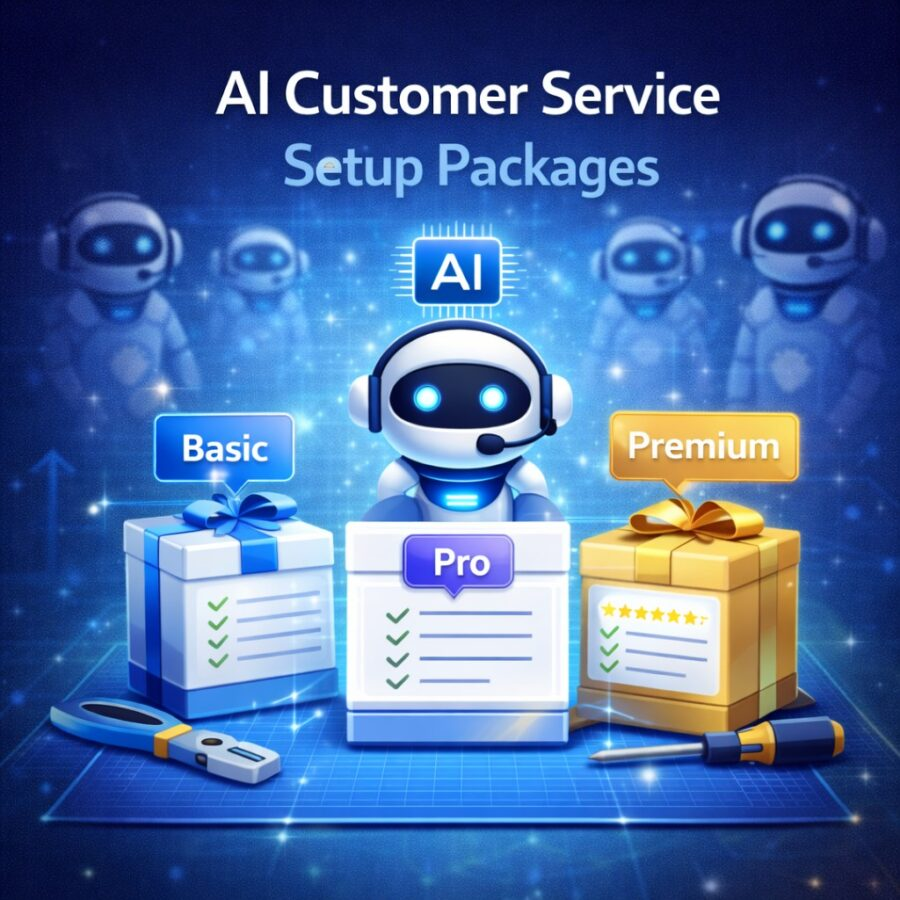
Here are three simple tiers:
Starter Setup
- Chat flows for top issues
- 10 help center articles
- Email templates and tags
Best for solo operators and tiny teams.
Growth Setup
- Everything in Starter
- 25 help center articles
- AI draft reply prompts and macros
- Basic reporting dashboard
Best for small businesses with consistent volume.
Managed Support System
- Everything in Growth
- Monthly content updates
- Transcript reviews and improvements
- Quarterly refresh of policies and FAQs
Best for owners who want it handled.
Owners love the Managed option because support content rots unless someone owns it.
The trust and transparency rules that keep customers happy
Because of the AI trust gap, your setup should be honest by design.
Include:
- A clear message when customers are interacting with automated help
- Easy access to a human
- Short, respectful questions
- No fake certainty on policies, refunds, or timelines
If you do this well, AI becomes a helpful assistant instead of a customer rage generator. Gartner’s data shows what happens when companies get this wrong. (Gartner)
Two prompts you can include as part of the deliverables
These help teams use AI consistently inside the system.
Prompt: You are a support agent assistant. Summarize this customer email in 3 bullets, suggest the best tag, and draft a reply using our policy notes. If policy is unclear, ask one clarifying question instead of guessing. Email: [paste]. Policy notes: [paste].
Prompt: You are a help center writer. Create a short article that answers this question in plain English. Include a 1-sentence summary, steps, and a “Common mistakes” section. Keep sentences short. Question: [paste].
What to measure so clients feel the ROI
Track a few simple numbers:
- First response time
- Ticket volume by category
- Self-service clicks and article usefulness
- Escalation rate from chat to human
Zendesk frames ticket deflection as reducing tickets with self-service resources like knowledge bases and chatbots. (Zendesk) So if your help center and chat are working, the support burden should shift toward fewer, more complex issues.
Affiliate Link
See our Affiliate Disclosure page for more details on what affiliate links do for our website.

Wrap-up
AI Customer Service Setup Packages work because they solve a real operational headache. Customers want fast help across channels. (Zendesk CX Trends 2026) Customers also distrust bot-first experiences when they feel trapped. (Gartner)
Your offer bridges both. Chat handles the basics and captures intent. Email becomes organized and consistent. The help center reduces repeat questions. Owners get a support system that feels modern, and customers get answers without the runaround.