Views: 1
Somewhere right now, a well-meaning employee is pasting a customer email thread into an AI tool and thinking, “This will save me ten minutes.” They might be right. They might also be pasting private info into the wrong place, generating a confident mistake, or sending a reply that sounds like a robot wearing a blazer.
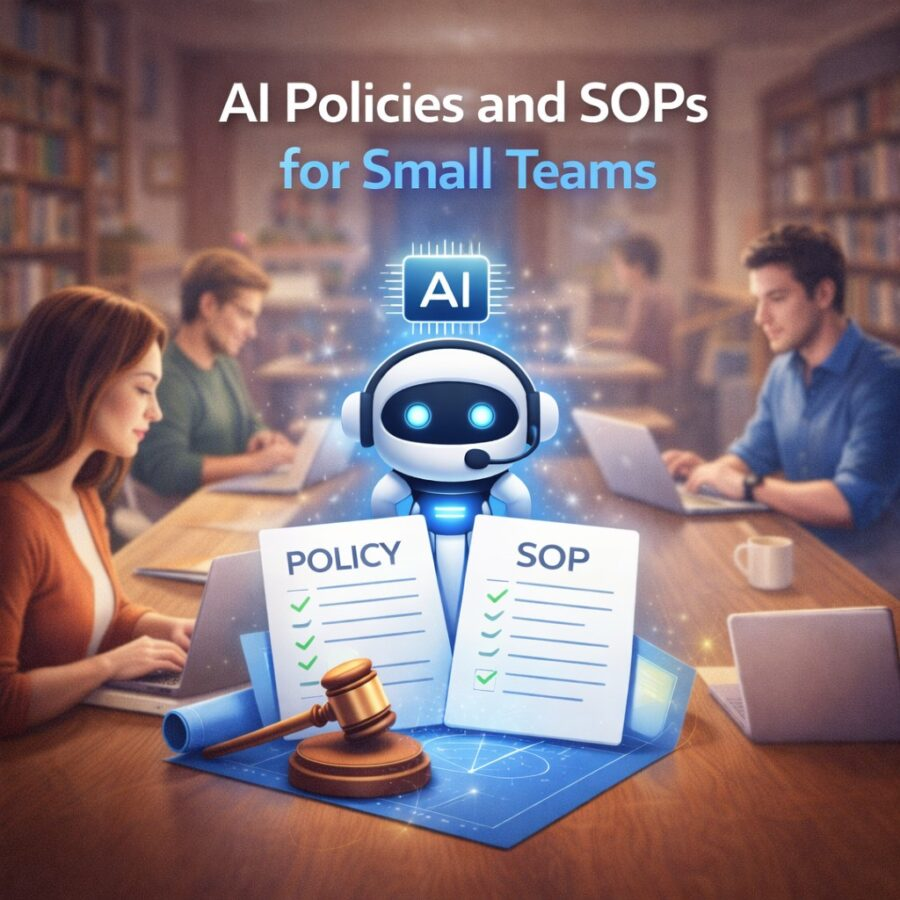
Small teams do not fail at AI because they are lazy. They fail because nobody sets the rules. That is why AI Policies and SOPs for Small Teams is a paid service business owners actually like buying. It lowers risk, cuts confusion, and keeps the benefits of AI without turning the company into a science experiment.
Why owners pay for AI Policies and SOPs for Small Teams
Owners love anything that reduces “randomness.” AI introduces randomness fast.
Without guardrails, teams run into three expensive problems:
First, inconsistent decisions. One employee uses AI carefully. Another uses it like a magic eight ball.
Second, data exposure and privacy messes. Even if nobody intends harm, bad habits spread.
Third, overconfident claims. The U.S. FTC has been loud about deceptive AI claims and “AI washing,” including enforcement actions where companies overstated capabilities without evidence. (Federal Trade Commission)
So when you sell AI Policies and SOPs for Small Teams, you are selling peace of mind. You are also selling speed, because a clear SOP makes the right behavior the default.
What “good enough” looks like for a small team
Most owners do not need a 60-page policy binder. They need a simple operating system.
A strong baseline includes:
A one-page AI Use Policy
What tools are allowed, what data is off-limits, and what tasks require human review.
A small set of SOPs
Short checklists for the 5 to 10 places AI is actually used.
A lightweight governance routine
A monthly check-in where the team reviews what changed, what broke, and what should be adjusted.
This is very aligned with the idea behind risk frameworks like NIST’s AI Risk Management Framework, which is designed to be practical, flexible, and usable across organizations of all sizes. (NIST Publications)
Affiliate Link
See our Affiliate Disclosure page for more details on what affiliate links do for our website.

The policy pieces that matter most
If you build AI Policies and SOPs for Small Teams as a service, these are the parts that drive the most value with the least complexity.
Approved tools and accounts
Which AI tools are allowed, who can sign up, and how accounts are secured.
Data boundaries
A plain-language definition of what can and cannot be pasted into AI. You can make it easy with a “stoplight” rule:
- Green: public info and internal non-sensitive info
- Yellow: internal info that needs review and redaction
- Red: customer personal data, health data, payment data, passwords, private contracts
Transparency and accountability expectations
The OECD AI Principles emphasize transparency, responsible disclosure, and accountability across the AI lifecycle. (OECD) Even if a small team is not building models, those principles still apply to how they use AI outputs.
Quality and human review
Define which outputs must be checked before sharing externally. For example: legal language, pricing, medical content, HR decisions, or anything that could cause harm.
Tone and brand voice
AI is great at being polite. It is also great at sounding generic. A policy that includes “voice rules” prevents bland content from leaking into customer communications.
SOPs that teams follow, not SOPs that collect dust
Here is the trick: make SOPs short enough to read while someone is busy.
A good SOP format for a small team:
- When to use AI
- What inputs are allowed
- What prompt structure to use
- What must be verified
- What gets saved as a record, if anything
If you want a rock-solid foundation, you can borrow the structure from NIST AI RMF. NIST describes four functions in the core: GOVERN, MAP, MEASURE, and MANAGE. (NIST Publications) You can turn those into a small-team SOP approach:
GOVERN: set roles and rules
MAP: list your AI use cases and what could go wrong
MEASURE: decide what “good” looks like and how you check it
MANAGE: fix issues, update prompts, and adjust access
That is a grown-up system, without the enterprise bloat.
A practical SOP set you can sell as a package
Owners love bundles because they can picture the result. Here is a set that fits most small teams:
Customer email SOP
AI can draft, human must verify facts, pricing, and promises.
Marketing content SOP
AI can outline and rewrite, human approves claims and ensures the offer is accurate. This also helps reduce the risk of deceptive marketing, which regulators care about regardless of whether AI wrote it. (Federal Trade Commission)
Support replies SOP
AI can summarize the issue and propose steps, human confirms the fix is real.
Meeting notes SOP
AI can summarize, human checks action items and removes sensitive details before sharing.
Hiring and HR SOP
AI can help draft job posts and interview questions, but avoid using it as an automated decision-maker. If a team is using personal data, fairness and data protection guidance becomes relevant, like the UK ICO’s AI and data protection guidance emphasizing fairness. (ICO)
Vendor and tool intake SOP
A simple checklist for what the team needs to know before adopting a new AI tool.
Affiliate Link
See our Affiliate Disclosure page for more details on what affiliate links do for our website.

The compliance layer you should not ignore
You do not need to turn this into legal consulting. You do need to keep owners out of obvious danger zones.
EU AI Act transparency
The EU AI Act includes transparency obligations, including informing users when they are interacting with an AI system in many contexts, unless it is obvious or certain exceptions apply. (Artificial Intelligence Act) If a small business serves EU customers, this becomes a practical policy item: disclose AI chat, label synthetic media when required, and avoid sneaky automation.
Truth in advertising
The FTC has taken action around overstated AI capabilities, including requiring evidence for claims about substituting for professional services. (Federal Trade Commission) Your SOPs should include a simple rule: do not promise what you cannot prove.
Why ISO style governance makes your service feel premium
If you want this offer to sound like “real business,” tie it to recognized governance concepts.
ISO/IEC 42001 is an AI management systems standard that provides guidance for responsible AI use, including risk assessment and treatment across AI projects. (ISO)
You are not telling small teams to get certified. You are saying: “We are building a lightweight version of the same discipline larger organizations follow.”
Owners like that. It signals maturity.
Deliverables that make AI Policies and SOPs for Small Teams easy to buy
Sell outcomes and artifacts, not meetings.
A clean paid service deliverable list:
- AI Use Policy, one page
Clear boundaries, tool list, approval rules. - AI Risk Snapshot, two pages
Top use cases, top risks, and simple controls, following the spirit of frameworks like NIST AI RMF. (NIST Publications) - SOP Pack, 5 to 10 SOPs
Each SOP is one page, checklist-first. - Prompt Standards Sheet
Reusable prompt formats, tone rules, and verification steps. - Rollout plan
A simple training agenda and a 30-day adoption check.
This is the moment where owners say, “Finally, someone made this usable.”
Pricing this service so it stays profitable
If you price per hour, you will end up arguing about time. Price as a package.
Starter
Policy plus 5 SOPs, single department.
Good for teams under 10.
Team
Policy, risk snapshot, 10 SOPs, prompt standards, 1 training session.
Managed
Everything in Team plus monthly updates and a quarterly refresh.
The pitch is simple: owners pay once to prevent ongoing chaos. If you add a monthly option, you create recurring income while keeping policies current.
Affiliate Link
See our Affiliate Disclosure page for more details on what affiliate links do for our website.

A fast implementation plan that fits real schedules
Here is a timeline that works for busy people:
Day 1: intake
Tools used, common tasks, sensitive data, customer types.
Day 2 to 3: map use cases
List where AI shows up and what could break.
Day 4 to 6: write the policy and SOPs
Keep each SOP short, with clear do and do not rules.
Day 7: review with the owner
Confirm boundaries and approvals.
Day 8 to 9: train the team
Short session, live examples, and a Q&A.
Day 10: launch and measure
Pick two simple checks: quality errors caught and time saved.
This kind of continuous improvement mindset lines up with how governance standards think about ongoing management, not one-and-done documentation. (ISO)
Prompts that help you produce the SOP pack faster
These are built to keep your output clean and consistent.
Prompt: Draft an “AI Use Policy” for a small team. Include: approved tools, banned data types, rules for customer-facing content, human review requirements, and a short incident response step list. Keep it under 600 words. Write in plain English.
Prompt: Create a one-page SOP checklist for this task: [task]. Include: when to use AI, approved inputs, a safe prompt template, required verification steps, and what to log. Keep each checklist item under 12 words.
How to sell AI Policies and SOPs for Small Teams as a side hustle
Your easiest buyers are owners who already feel AI pressure.
Target:
- agencies
- local service businesses with admin staff
- small ecommerce brands
- small professional firms that create lots of client-facing writing
Your outreach hook:
“I help small teams use AI without mistakes. You get a one-page AI policy plus SOPs your team can follow. It reduces risk and makes output consistent.”
Then offer a tiny audit:
- Ask what tools they use
- Ask where AI touches customers
- Ask what data they worry about
- Show them the gaps
The service sells itself when the owner realizes the current system is “hope.”
Wrap-up
AI is not going away. The messy part is not the tech. The messy part is people improvising with it.
AI Policies and SOPs for Small Teams is a paid service owners love because it turns AI from a risky toy into a safe tool. You give clear rules, simple checklists, and a rollout plan that fits real life. That is how you get paid, and how clients sleep better.