Views: 0
There is a small sound that can cost a local service business thousands of dollars.
It is the click of a customer backing out of Google Maps.
They did not hate you. They did not even meet you. They just saw two things that made them nervous: a thin review profile, and a listing that looked like a half-finished form. Then they picked the next company that felt safer.
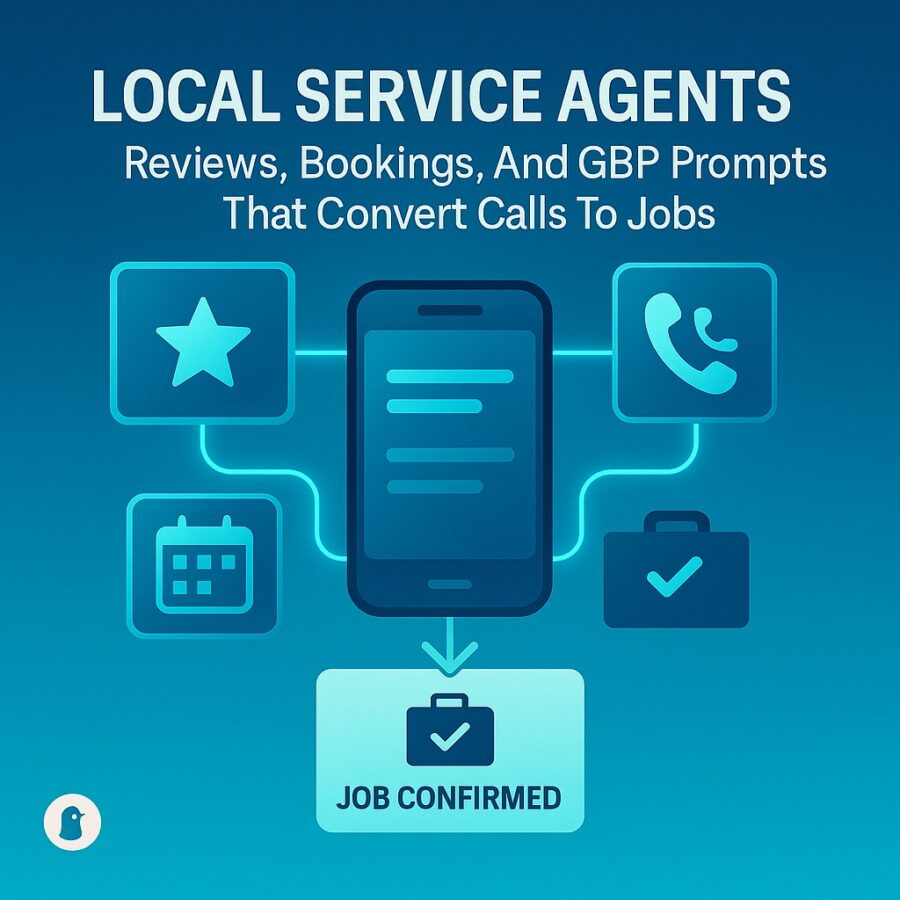
That is why Local Service Agents: Reviews, Bookings, And GBP Prompts That Convert Calls To Jobs is not about “marketing tricks.” It is about building a steady, practical system that turns local intent into real jobs, without begging, spamming, or sounding like a robot.
A “local service agent” in this article means a repeatable workflow, powered by AI, that handles five outcomes:
- Earn and manage reviews the right way
- Keep bookings and appointment links frictionless
- Keep your Google Business Profile (GBP) complete and active
- Convert calls into scheduled work
- Track what is working so you can improve it
Think of it like a well-run front desk. Not fancy. Not pushy. Just dependable.
Why local customers decide fast and forget faster
Local search is a pressure cooker. The customer has a need, a time limit, and a low tolerance for uncertainty.
They are not browsing. They are triaging.
Your GBP is the lab report they skim before they pick a technician. Reviews are the “peer review” layer. Your photos, services, hours, and Q and A are the supporting evidence. If anything looks off, they move on.
BrightLocal’s research lines up with what many owners feel in their bones: reviews and rating thresholds change behavior. For example, BrightLocal reports that a large share of consumers will not consider a business under a certain star rating, and review patterns influence trust. (BrightLocal)
Here is the uncomfortable truth: a local customer often decides before they call.
So your goal is not merely to answer the phone better. Your goal is to make the call happen in the first place, and then make the call easy to turn into a job.
Reviews are not “nice to have” anymore
A review is not just feedback. It is a decision shortcut.
BrightLocal’s Local Consumer Review Survey 2025 notes shifting behavior around where people read reviews and how many sources they use. (BrightLocal) That matters because it means your Google presence can carry more weight than it used to.
Two practical consequences follow:
- Recency matters. Old praise feels stale in a world that changes weekly.
- Specificity matters. “Great service” is fine, but “fixed my furnace the same day, explained the parts, cleaned up after” sells.
Also, fake review enforcement has become stricter in certain regions, with public commitments from Google to crack down on review fraud and penalize manipulation. (AP News)
So the safest long-term strategy is boring in the best way: earn real reviews, respond consistently, and do not get clever with policy loopholes.
The rules: how to ask for reviews without getting yourself in trouble
If you run a local business, you will eventually hear someone suggest a shortcut:
- “Offer a discount if they leave a 5-star review.”
- “Only ask happy customers to review.”
- “Send them to a private survey first, then only share the Google link if they score you high.”
That last one is called review gating, and it is explicitly discouraged. Google’s policies prohibit incentives for reviews and discourage practices that distort genuine experiences. (Google Help)
Google’s own guidance for getting more reviews is straightforward: remind customers, share a review link or QR code, reply to feedback. (Google Help)
A simple compliance mindset helps:
- Invite everyone. Do not filter by mood.
- Do not pay for praise. No gifts, no discounts, no “free add-on” tied to a review. (Google Help)
- Make it easy. One link, one QR, one gentle sentence. (Google Help)
- Respond like a human. Thank them, reference the job type, keep it short.
If your local service agent does nothing else, make it enforce these rules automatically.
Bookings: the fastest way to stop losing “ready to schedule” customers
Many local customers do not want to call. They want to tap.
Google Business Profile supports bookings through providers and the setup lives directly in your Business Profile experience. Google’s help documentation explains the basic path: open your profile, select Bookings, choose a provider, and Google can display it on your listing. (Google Help)
This is one of the simplest “conversion upgrades” available because it removes a decision point.
Analogy time: asking someone to call when they are ready to book is like making a hungry person fill out paperwork before they can look at the menu. They might do it, but only if they are desperate.
Bookings reduce friction. Less friction means more scheduled work.
Also, Local Services Ads can surface scheduling and lead actions directly in the ad experience, including calls, messages, or booking requests, depending on category and setup. (Google Business)
So your system should treat booking links like a first-class asset, not an afterthought.
The conversion path: from Google to job, step by step
A clean local conversion path usually looks like this:
- Customer searches “plumber near me” or “HVAC repair [town]”
- They scan the map pack
- They open 2 or 3 listings
- They check rating, review volume, recency, and the tone of responses
- They look for fast proof: photos, services, hours, service area
- They tap Call or Book
- A human conversation happens
- The job gets scheduled
- A review request goes out after completion
- Review comes in, you reply, cycle strengthens
A local service agent is simply the set of prompts and procedures that keeps every stage tight.
If you want one mental model, borrow from logistics: your job is not to “sell harder.” Your job is to reduce dropped packages. Every missed call, unreturned message, or unanswered review is a package left on the loading dock.
Affiliate Link
See our Affiliate Disclosure page for more details on what affiliate links do for our website.

What a Local Service Agent actually does in plain English
You can run this with a notebook and discipline, or with AI plus discipline. Either way, the agent’s responsibilities are predictable.
Agent responsibilities
Reviews
- Create compliant review requests
- Draft responses for positive, neutral, negative feedback
- Flag reviews that may violate policy for reporting (without rage)
Bookings
- Keep booking links current
- Draft appointment confirmations and prep messages
- Turn “maybe next week” into a scheduled slot
GBP freshness
- Draft weekly posts
- Maintain services, service areas, business description
- Seed Q and A with common questions and crisp answers
Calls
- Provide a call script that sounds natural
- Summarize calls into job tickets
- Produce follow-up texts and estimate reminders
Measurement
- Track call outcomes, booked rate, review velocity, and no-show patterns
- Suggest one improvement per week, not twenty
That is it. No magic.
The parts of GBP that quietly make you money
Google’s own guidelines focus on accurate representation and quality information. (Google Help) If your listing is missing key fields, you are effectively wearing mismatched shoes to an interview. You may still get the job, but you make it harder.
Here are the GBP elements that commonly move the needle for local services:
- Primary category and secondary categories (choose honestly)
- Service list with clear wording
- Service area and hours (including holiday changes)
- Photos that prove real work
- Booking links (if you can support them)
- Regular posts that show you are active
- Review replies, especially to critical feedback
- Q and A responses that remove uncertainty
Treat your GBP like a storefront window. Nobody buys from a shop that looks closed, confusing, or unattended.
The review reply method: “calm, specific, future-focused”
When people talk about review replies, they often drift into PR language. Do not do that. You are a local operator, not a press secretary.
A strong reply uses three moves:
- Calm thanks
- Specific reference (job type or outcome, without revealing private details)
- Future-focused invite (“call us if anything needs adjustment”)
Negative reviews require one extra move: propose a next step and take it offline.
This keeps you compliant, sane, and credible.
Affiliate Link
See our Affiliate Disclosure page for more details on what affiliate links do for our website.

GBP prompts that produce real-world outputs
Below are prompts you can paste into ChatGPT and run as part of your weekly workflow. Each one is designed to create something you can use immediately, with minimal editing.
1) Prompt: Build your “review response voice”
Prompt: You are writing Google Business Profile review replies for a local service company. Use a calm, helpful tone. Never use corporate jargon. Keep replies under 70 words. Ask for a first name only. Do not mention discounts or incentives. Create 10 reply templates: 4 for positive reviews, 3 for neutral reviews, 3 for negative reviews. Each template must include: (1) thanks, (2) a specific service reference placeholder, (3) a simple next step or reassurance line. Provide them in a numbered list.
2) Prompt: Reply to a negative review without making it worse
Prompt: Draft a reply to this Google review. Requirements: calm tone, no blame, no excuses, no legal threats, no private details. Offer a clear next step to resolve the issue offline. Keep it under 90 words. Review text: [PASTE REVIEW]. Business name: [NAME]. Contact method: [PHONE OR EMAIL].
3) Prompt: Turn job notes into a review request message
Prompt: Create a short review request message that I can send by text after a completed job. Follow Google policy: no incentives, no pressure, invite all customers equally. Keep it under 240 characters. Include a friendly thank you, the service performed in plain words, and this review link: [PASTE LINK]. Job notes: [PASTE NOTES].
Google even recommends sharing a review link or QR code to make leaving feedback easier. (Google Help)
4) Prompt: Produce a QR code handout script (for in-person jobs)
Prompt: Write a 20-second script a technician can say at the end of a job to request a Google review politely. Rules: no incentives, no pushing for 5 stars, invite honest feedback, and make it feel natural. Mention that the customer can scan a QR code on a small card. Provide 3 variations: friendly, more formal, and very brief.
5) Prompt: Generate weekly GBP posts that do not sound like ads
Prompt: Create 8 Google Business Profile posts for a local service business. Each post must be 120 to 180 words, plain English, no hype. Mix themes: seasonal tips, common problems, behind-the-scenes, safety checks, simple maintenance, and a short customer story without personal details. End each post with one gentle call to action: call, message, or book. Business type: [PLUMBER/HVAC/ELECTRICIAN]. Service area: [CITY/COUNTY]. Specialties: [LIST].
6) Prompt: Write service descriptions that match how customers search
Prompt: Rewrite my service list for Google Business Profile so it matches local search language. Output: 12 services with short descriptions (30 to 45 words each). Keep every description specific, practical, and free of fluff. Business type: [TYPE]. Current services: [PASTE]. Include common “near me” intent terms naturally without keyword stuffing.
7) Prompt: Build a GBP Q and A library that prevents bad leads
The Q and A section can reduce confusion and save you time. Many reputation guides recommend answering questions promptly and directly on Google. (Reputation)
Prompt: Create a Google Business Profile Q&A pack for a local service business. Output 20 questions customers actually ask before calling. Then answer each in 1 to 3 sentences. The answers must: set expectations, mention service area boundaries, clarify emergency availability, explain pricing approach without quoting exact prices, and encourage booking. Business type: [TYPE]. Service area: [AREA]. Hours: [HOURS]. Emergency policy: [DETAILS].
8) Prompt: Convert a phone call into a job ticket
Prompt: I will paste raw notes from a phone call. Convert them into a clean job ticket with headings: Customer, Address, Contact, Problem Summary, Observations, Safety Risks, Tools/Parts Likely Needed, Estimated Duration, Scheduling Constraints, and Next Step. Keep it practical. Notes: [PASTE].
9) Prompt: Missed-call rescue message that gets replies
Prompt: Write a missed-call follow-up text that sounds human and gets a response. Keep it under 240 characters. Include: acknowledgment of the missed call, one question to identify the service needed, and an option to book by link. Booking link: [LINK]. Business name: [NAME].
10) Prompt: Booking confirmations that prevent no-shows
Prompt: Create a booking confirmation text and a day-before reminder text for local service appointments. Use plain English. Include arrival window, what to prepare (pets, access, breaker panel, etc.), and an easy reschedule line. Provide 3 variants: repair call, estimate visit, and maintenance tune-up.
11) Prompt: Local Services Ads lead triage (if you run LSAs)
Local Services Ads can deliver leads as calls and messages, and you manage them through Google’s local services flow. (Google Help)
Prompt: Help me triage Local Services Ads leads. I will paste lead details. Output: (1) lead quality score 1 to 5, (2) the best next message to send, (3) one scheduling option to offer, (4) one disqualifying question to prevent wasted trips. Lead details: [PASTE]. My services: [LIST]. My service area limits: [LIMITS].
The booking setup: treat it like an on-ramp, not a feature
Google’s own steps for setting up bookings in GBP are simple, but the payoff depends on what happens next. (Google Help)
A functional booking experience needs:
- A real calendar with real availability
- A short intake form that collects the minimum needed
- A confirmation message that sets expectations
- A reminder message that reduces ghosting
- A reschedule method that is painless
If any of these are missing, bookings can create new headaches.
Analogy: booking links are like installing an automatic door. Great idea, until the door sticks halfway and customers bump into it. Smooth matters.
A call that converts is usually boring in a good way
Many owners think the secret is a clever script.
In practice, conversion happens because of four habits:
- Answer fast, or follow up fast
- Confirm the problem in the customer’s words
- Offer a clear next step, not a vague promise
- Send a simple confirmation so the customer feels progress
Local Services Ads exists because customers want fast choices and immediate contact options, often at the top of search results for service categories. (Google Business)
So your local service agent should help you do the unglamorous basics every time.
A simple call flow you can teach in one afternoon
- Greeting: business name, your name
- Identify: “What’s going on today?”
- Confirm: repeat the issue plainly
- Filter: service area, timing, safety concerns
- Offer: earliest slot or booking option
- Close: confirm address, contact, next message they will receive
Then you use AI to summarize the call, draft the confirmation text, and create the job ticket.
That is how calls become jobs without needing a silver tongue.
The weekly rhythm: the “15-minute local flywheel”
If you want this to be sustainable, you need a schedule that does not collapse when work gets busy.
Here is a weekly cadence that many small teams can handle:
Twice per week (5 minutes):
- Check new reviews
- Draft replies
- Publish replies
Once per week (10 minutes):
- Post one GBP update
- Add one photo from a real job
- Review your booking links and hours
After every completed job (30 seconds):
- Send review request link or QR handoff
Google explicitly suggests reminding customers and sharing a review link or QR code, which makes that 30-second habit very high leverage. (Google Help)
This is not a content marketing calendar. It is maintenance, like changing the oil so the engine does not seize.
The trust layer: what you should never automate blindly
AI is helpful, but not all parts of the workflow deserve autopilot.
Keep a human in the loop for:
- Negative review replies
- Any mention of refunds, liability, or disputes
- Medical, safety, or hazardous service situations
- Pricing commitments
- Personal data handling
Also, stay inside Google’s policies on fake engagement and incentivized reviews, because penalties can include restrictions or other consequences if violative activity is detected. (Google Help)
If your local service agent’s only job is to protect you from avoidable mistakes, it will still pay for itself.
A practical “conversion checklist” for your GBP
Use this as a quick audit.
- Listing verified and accurate (name, address, phone, hours) (Google Help)
- Primary category correct, services filled in
- Booking enabled if applicable (Google Help)
- Photos show real work, not only logos
- Reviews: steady pace, recent replies visible
- Review requests follow policy, no incentives (Google Help)
- Q and A answered clearly (Reputation)
- Posts updated regularly, not spammy
- Missed-call follow-up process exists
- Call notes become job tickets consistently
Do not aim for perfect. Aim for maintained.
Affiliate Link
See our Affiliate Disclosure page for more details on what affiliate links do for our website.
A short case study example you can copy (without pretending it is magic)
Imagine a two-truck HVAC business in a mid-sized town.
Before the system:
- Missed calls vanish
- Reviews arrive randomly
- GBP posts happen when someone remembers
- Bookings are not enabled
- Negative reviews sit unanswered for months
After the system:
- Missed calls get a follow-up text in five minutes
- Every finished job gets a compliant review invite
- Reviews are replied to twice weekly
- One GBP post goes out every Wednesday
- Bookings link removes friction for busy customers
- Call notes become tickets, so techs show up prepared
Nothing about this is glamorous. Yet the customer experience becomes smoother. And smooth is what people pay for.
Like a well-designed tool in a workshop, you stop fighting the process and start using it.
When the phone rings again
If you take only one lesson from Local Service Agents: Reviews, Bookings, And GBP Prompts That Convert Calls To Jobs, take this:
Local growth is rarely about convincing strangers. It is about removing reasons to hesitate.
Reviews remove doubt. Bookings remove friction. A maintained GBP removes confusion. A consistent call process removes drop-offs.
Do that long enough and you build a quiet advantage that competitors struggle to copy, because it is not a hack. It is a habit.