Views: 1
Meetings rarely fail because people are lazy. They fail because information scatters.
An agenda lives in one place. Notes land in someone’s notebook. Decisions get spoken, then forgotten. Tasks drift into a chat thread, then sink. A week later, nobody is sure what was agreed on, who owns what, or what “next” even means.
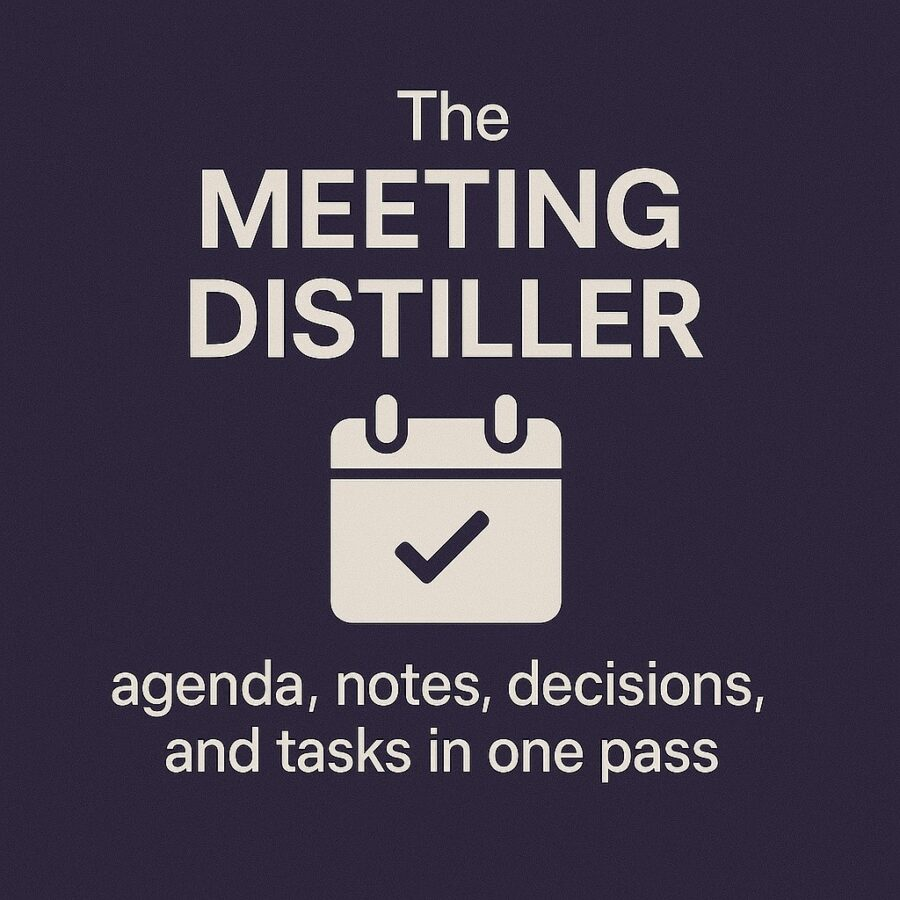
The Meeting Distiller: Agenda, Notes, Decisions, & Tasks in One Pass is a simple system to stop that drift. You use one template and one guided prompt to capture four outputs in one sweep: agenda, notes, decisions, and tasks. The goal is not beautiful documentation. The goal is reliable momentum.
If you have ever left a meeting with that uneasy feeling of “we talked a lot but nothing changed,” this is for you.
Why meetings turn into fog
A meeting is a live event. It moves fast. People interrupt. Someone says something important, then the group jumps to the next topic. Later, we remember the emotion, not the details.
A solid agenda reduces that chaos by setting expectations, helping people prepare, and keeping the group on track. Harvard Business Review makes this point directly: effective agendas clarify what must happen before and during the meeting, and they help allocate time wisely. (Harvard Business Review)
But even a good agenda does not guarantee a useful record. That is why the “distiller” matters. It forces four buckets that convert talk into action.
The core idea behind The Meeting Distiller: Agenda, Notes, Decisions, & Tasks in One Pass
“Distilling” is a helpful metaphor. When you distill something, you remove noise and keep what matters.
In a meeting, what matters is usually:
- Agenda: what we are here to do
- Notes: what was said that changes understanding
- Decisions: what we chose, including tradeoffs
- Tasks: who will do what, by when, with what definition of done
This is not a new list. Atlassian’s meeting notes template, for example, emphasizes capturing attendees, agenda, discussion topics, action items, decisions, and next meeting details. (Atlassian)
The novelty is doing it in one pass, with one structure, every time.
What “one pass” actually means in practice
“One pass” does not mean “no thinking.” It means you avoid multiple rounds of messy cleanup.
You do the work once, at the right time, using two moves:
- Before the meeting: load the agenda into the template
- After the meeting: paste raw notes or a transcript into the distiller prompt and generate the final record
If you want to go even faster, you can capture notes directly in a shared doc during the meeting and run the distiller immediately afterward.
Microsoft Teams supports meeting notes where you can add an agenda, notes, and tasks in one place, shared with attendees. (Microsoft Support)
That is exactly the spirit of this method: one meeting, one home for the truth.
The Meeting Distiller template
Use this layout in Google Docs, Notion, Confluence, Word, or Teams. Keep it consistent. Consistency is what makes the system fast.
Header
- Meeting title
- Date and time
- Attendees (and who was absent)
- Purpose in one sentence
Agenda
- Topic 1 (owner, time box, desired outcome)
- Topic 2 (owner, time box, desired outcome)
- Topic 3 (owner, time box, desired outcome)
Notes
- Highlights only
- Context needed to understand decisions
- Links or references
Decisions
- Decision
- Options considered
- Why this choice won
- Any constraints
Tasks
- Task
- Owner
- Due date
- Definition of done
- Dependencies
Parking lot
- Topics that matter, but not today
This structure matches what many meeting-minute guides recommend: record agenda items discussed, decisions reached, and action assignments with responsible owners. (Center for Faculty Excellence)
The pre-meeting move that makes everything easier
You do not need a fancy prep routine. You need a short, repeatable one.
Harvard Business School’s Working Knowledge notes that meeting prep should be brief and focused: solicit agenda items, prepare the agenda, and communicate it. It also warns against long slide decks created only for the meeting. (Harvard Business School Library)
Try this:
- Ask for agenda items 24 hours before
- Select the top three topics
- Assign an owner to each topic
- Time-box each item
- Define the outcome for each item: decide, align, brainstorm, or review
When an agenda item has no outcome, it becomes a conversational cul-de-sac.
Affiliate Link
See our Affiliate Disclosure page for more details on what affiliate links do for our website.

How to write agenda items that lead to decisions
Most weak agendas contain nouns.
“Website.” “Marketing.” “Budget.” “Hiring.”
Nouns do not tell people what to do. Verbs do.
Here are stronger versions:
- Decide the homepage headline and primary call to action
- Choose the two channels we will focus on this month
- Approve the spend cap and the reporting cadence
- Pick the interview panel and the timeline
This is consistent with the idea that an effective agenda clarifies expectations and signals when discussion is complete. (Harvard Business Review)
The distiller prompt you can paste into ChatGPT
Use this after the meeting. Feed it your raw notes, a transcript, or a chaotic bullet list. It will produce a clean record that matches the template.
Prompt: You are The Meeting Distiller. Convert the raw meeting text into a clean record with agenda, notes, decisions, and tasks.
INPUTS
- Meeting title: [TITLE]
- Date/time: [DATE]
- Attendees: [NAMES]
- Purpose (one sentence): [PURPOSE]
- Agenda (if known): [AGENDA OR “unknown”]
- Raw notes or transcript: [PASTE RAW TEXT]
RULES
- Use plain English.
- Do not invent facts. If something is unclear, label it as [NEEDS CONFIRMATION].
- Keep sentences short.
- Output must be scannable.
OUTPUT FORMAT
- Agenda (with outcomes and time boxes if available)
- Notes (highlights only, no filler)
- Decisions (each decision as a bullet with rationale)
- Tasks (each task must have owner, due date if stated, and definition of done)
- Parking Lot
- Risks or Blockers (if mentioned)
- Follow-up Questions (max 5)
This prompt is designed to mimic what good templates already encourage: a structured record with action items and decisions, shared quickly so accountability stays intact. (Atlassian)
Affiliate Link
See our Affiliate Disclosure page for more details on what affiliate links do for our website.
This offer is for NEW USERS to Coinbase only!

Alt+Penguin’s Referral link details for NEW Coinbase users
When using our referral link (click here or the picture above) and you sign-up for a NEW Coinbase account & make a $20+ trade, you will receive a FREE $30 to your Coinbase account!
Turning vague action items into real tasks
Here is where most teams lose value.
People say: “We should look into that.”
Nobody hears: “Who, by when, and what counts as done?”
Your tasks need four fields, minimum:
- Owner
- Deadline
- Deliverable
- Done definition
A simple way to tighten tasks is to borrow SMART thinking, which frames objectives as specific, measurable, achievable, relevant, and time-bound. (Atlassian)
You do not need to turn every task into a performance goal. You just need clarity.
Example: weak vs strong task
Weak: “Update the landing page.”
Strong: “Jordan updates the landing page headline and hero section by Thursday 3 PM. Done means the new version is live and tracked with one A/B test.”
That single revision prevents follow-up meetings that exist only to decode the previous meeting.
A clean way to capture decisions so they do not get rewritten later
A decision is not just a sentence. It is a commitment that closes doors.
When you record decisions, include:
- What we decided
- Alternatives we considered
- Why this option won
- Any constraints or assumptions
This reduces the most common meeting argument: revisiting the same choice because context disappeared.
Meeting note templates often emphasize “captures key decisions” as a major benefit, precisely because it reduces miscommunication later. (Atlassian)
The “two-minute recap” that locks in accountability
Before people leave, run a short recap:
- Read the decisions out loud
- Read each task with owner and due date
- Ask if anything is missing
- Confirm where the record will live
This is not ceremony. It is quality control.
If you do this consistently, your meetings begin to feel lighter, because fewer people worry that details will vanish.
How to use The Meeting Distiller: Agenda, Notes, Decisions, & Tasks in One Pass for different meeting types
Weekly team sync
Goal: alignment and unblocking.
Keep the agenda fixed:
- Wins since last week
- Blockers
- Priorities for next week
- Decisions needed
- Tasks
A recurring meeting notes template is ideal for this, because it lets you track notes, decisions, and action items across sessions. (Atlassian)
Project meeting
Goal: progress and tradeoffs.
Use agenda items like:
- Status against milestones
- Risks and blockers
- Decisions required this week
- Task updates
1-on-1
Goal: clarity, support, growth.
Confluence even provides 1-on-1 templates that guide recurring discussions. (Atlassian)
For distilling, focus on:
- Key updates
- Commitments by each person
- Follow-ups
Client call
Goal: avoid misunderstandings.
Record:
- What the client asked for
- What you agreed to deliver
- What is out of scope
- Deadlines
The “out of scope” line alone can save you hours.
A realistic example of the distiller in action
Imagine a short meeting about a content plan.
Raw notes might look like this:
- “Need faster posting. Current workflow too slow.”
- “Pick 2 content pillars.”
- “Make a weekly schedule.”
- “Someone to draft prompts.”
- “Decide: Shorts or blog first?”
- “Next meeting Monday.”
After distilling, you get something like:
Decisions
- We will prioritize blog posts first, then repurpose into short videos to reduce duplication.
- We will use two pillars: AI side hustles and prompt engineering workflows.
Tasks
- Alex drafts a 4-week content calendar by Friday 5 PM. Done means dates, topics, and formats are listed.
- Sam creates a prompt pack outline for the first pillar by Thursday noon. Done means 15 prompt titles with use cases.
Notice the difference. The meeting now produces movement.
Affiliate Link
See our Affiliate Disclosure page for more details on what affiliate links do for our website.

Common failure points and how to fix them
Failure 1: the agenda is a wish list
Fix: keep it to three main topics. Put everything else in the parking lot.
Failure 2: notes become a transcript
Fix: capture highlights only. Save transcripts separately if needed.
Templates often emphasize that meeting notes are not transcripts. They summarize what matters. (Atlassian)
Failure 3: decisions are implied, not recorded
Fix: write decisions during the meeting and read them back in the recap.
Failure 4: tasks have no owner
Fix: a task without an owner is a suggestion. Assign names.
Failure 5: tasks have no due date
Fix: if no date exists, set a review date. “Check in next Tuesday” still creates a timer.
Where AI fits, and where you still need judgment
AI is excellent at restructuring messy text. It is also capable of producing confident nonsense if you let it guess.
That is why the distiller prompt includes two guardrails:
- “Do not invent facts.”
- “Label unclear items as [NEEDS CONFIRMATION].”
Use AI for formatting and clarity. Use humans for truth and priorities.
Atlassian explicitly recommends sharing notes quickly and using tools to keep action items relevant. It even calls out AI assistants as a way to capture key takeaways without assigning a dedicated note-taker. (Atlassian)
How to make the system stick without turning it into bureaucracy
Adoption fails when the system feels like extra work.
Make it feel like relief.
Try these habits:
- Keep the template short
- Send the distilled record within 30 minutes
- Store it in one predictable place
- Start the next meeting by reviewing last meeting’s tasks
If people see that the record changes behavior, they will use it. If it becomes a document nobody reads, it will die quietly.
Microsoft Teams highlights that meeting notes can include agenda, notes, and tasks that others can view and edit. Shared ownership helps adoption. (Microsoft Support)
A quick checklist you can run every time
Use this before you send the final notes.
- Purpose is one sentence
- Agenda items have outcomes
- Decisions are explicit
- Tasks have owner, date, and done definition
- Parking lot is not empty if scope was tight
- Follow-up questions are listed if anything was unclear
If you hit these points, you will run better meetings without needing a longer meeting.
The payoff of The Meeting Distiller: Agenda, Notes, Decisions, & Tasks in One Pass
The benefit is not “better notes.” The benefit is less repeated work.
When your meeting record is clean:
- People stop asking for status in five different places
- Decisions stop looping
- Tasks stop disappearing
- Next meetings start faster, because context is ready
That is what efficiency looks like in the real world. Not frantic speed, but fewer do-overs.