Views: 2
Picture a student handing in a paper that looks confident, flows well, and still has one fatal flaw: the thesis quietly contradicts the evidence. I’ve seen it a hundred times. Not because the student is careless, but because first drafts lie to us. They feel finished long before they are.
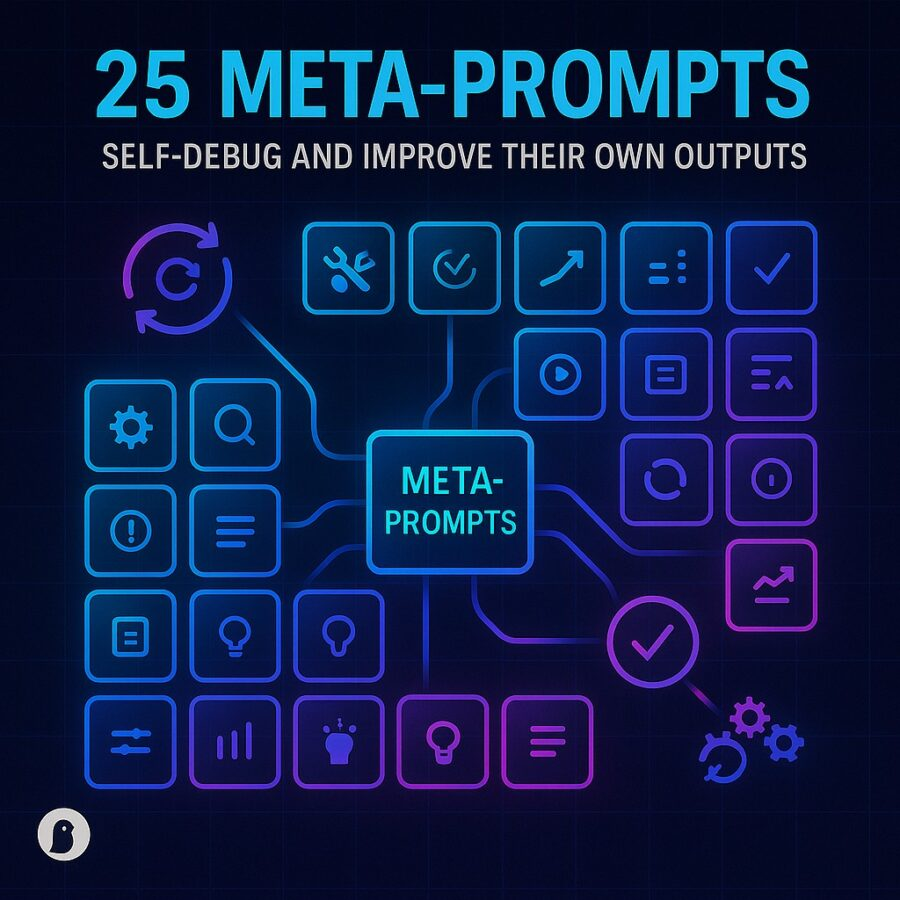
That is the real promise behind the SEO keyphrase Meta Prompts That Self-Debug & 25 Improve Their Own Outputs. You are not hunting for a magical “perfect prompt.” You are building a repeatable editing loop, like giving the model a decent red pen and a checklist, then telling it to use both before it speaks.
Researchers have explored several versions of this idea: iterative self-feedback loops, self-reflection with memory, and verification steps designed to reduce hallucinations. (OpenReview)
Why “one-shot” outputs fail in the real world
Large language models are excellent at producing plausible text. Plausible is not the same as correct. If you ask for a list of facts, it may confidently invent a few that sound right. If you ask for strategy, it may give advice that is tidy but mismatched to your constraints. This problem is so common that entire prompting methods now focus on getting a model to draft, then interrogate its own draft, and only then finalize. (arXiv)
A helpful way to think about it is a chemistry lab. Your first measurement is rarely the final number you record. You re-check the scale, confirm the units, and repeat the step if something feels off. Meta prompting is the same mindset: treat the first output like a measurement that needs confirmation.
What a meta prompt really is
A normal prompt asks for an answer. A meta prompt asks for a process that produces a better answer.
In practice, meta prompts do at least one of these:
They force a second pass that critiques structure, logic, or clarity.
They require a verification plan, like generating questions that can catch errors.
They compare multiple candidate drafts and pick the best parts.
They use a rubric so “better” has a clear meaning.
This is closely related to research on iterative refinement using self-feedback, and reflection-driven improvement over repeated attempts. (OpenReview)
Affiliate Link
See our Affiliate Disclosure page for more details on what affiliate links do for our website.
This offer is for NEW USERS to Coinbase only!

Alt+Penguin’s Referral link details for NEW Coinbase users
When using our referral link (click here or the picture above) and you sign-up for a NEW Coinbase account & make a $20+ trade, you will receive a FREE $30 to your Coinbase account!
The self-debug loop that actually works
If you want a reliable pattern you can reuse across writing, business workflows, or even code tasks, use a loop like this:
- Draft fast
Get a complete answer on the page. No perfection. - Critique with a rubric
Ask the model to grade the draft against specific requirements: audience, tone, completeness, and constraints. - Verify what can be verified
For factual or technical claims, have it generate checks. Chain-of-Verification is a formal version of this idea: draft first, then create verification questions, answer them independently, then revise. (arXiv) - Rewrite with constraints locked
The rewrite prompt should preserve your rules: word count, format, voice, and any must-include items.
If you publish or sell things with AI, this loop is the difference between “looks fine” and “holds up when a reader tries to use it.”
Guardrails that keep self-editing from going sideways
Meta prompting can backfire if you let the model “optimize” in the wrong direction. A few rules prevent that.
Make the rubric concrete. “Make it better” is vague. “Cut fluff, add one example, keep under 180 words” is measurable.
Separate critique from rewriting. When you mix them, you get sloppy edits.
Ask for targeted fixes, not endless perfection. Two revision passes usually beat ten fussy ones.
Use eval thinking if you repeat a workflow. OpenAI’s eval guidance boils down to a simple point: if outputs vary, you need tests that reflect what you actually care about. (OpenAI Platform)
25 meta prompts you can reuse anywhere
Below are 25 templates designed to self-debug and improve outputs. Swap in your topic, audience, and constraints. Use them as-is, or chain them into a draft → critique → revise pipeline.
A. Clarity and scope prompts
- Prompt: Before answering, restate my goal in one sentence, list 5 assumptions you are making, then ask 3 clarification questions. If any assumption seems risky, flag it.
- Prompt: Write a “scope lock” for this task: what you will cover, what you will not cover, and what success looks like in 3 bullet points.
- Prompt: Summarize my request as requirements using MUST, SHOULD, and MUST NOT. Then produce the answer that satisfies every MUST.
- Prompt: Generate the simplest version of the answer first. Then create a “version 2” that adds depth only where it increases usefulness.
- Prompt: Identify the top 3 ways your answer could misunderstand my intent. Revise to remove those failure modes.
B. Structure and reasoning prompts
- Prompt: Create 3 different outlines for the answer with distinct structures. Choose the best outline for my audience and explain why in 2 sentences. Then write using that outline.
- Prompt: After drafting, run a logic check: list claims that depend on earlier claims. Mark any leaps in reasoning. Patch the gaps with clearer steps.
- Prompt: Write the answer, then produce a “stress test” section: what objections would a skeptical reader raise? Update the answer to address the strongest objection.
- Prompt: Provide two competing solutions. Compare tradeoffs across cost, time, risk, and complexity. Recommend one with a short justification.
- Prompt: Generate 5 alternative approaches. Score them 1–10 for feasibility. Pick the top 2 and write the final answer using the best one.
C. Accuracy and hallucination control prompts
- Prompt: Separate your response into: (1) what you are confident is correct, (2) what might be wrong, and (3) what needs a source. Then rewrite so uncertain items are clearly labeled.
- Prompt: Draft the answer. Then create 8 verification questions that would catch factual mistakes. Answer those questions independently. Revise the draft using only verified points.
- Prompt: List every factual claim you made. For each, propose how a reader could verify it quickly. Rewrite to reduce uncheckable claims.
- Prompt: Find the weakest paragraph in your answer. Explain why it is weak. Replace it with a stronger paragraph that is more specific and testable.
- Prompt: Run a “numbers audit.” If you used statistics, dates, or quantities, list them in a table and confirm they match the context. If you cannot confirm, remove or soften them.
(These are practical cousins of verification and self-correction research, including Chain-of-Verification and studies on when self-correction succeeds.) (ACL Anthology)
Affiliate Link
See our Affiliate Disclosure page for more details on what affiliate links do for our website.

D. Style, voice, and readability prompts
- Prompt: Rewrite for a smart reader who is tired and busy. Shorten sentences, remove filler, and keep the tone calm and helpful.
- Prompt: Give me 3 tone options: friendly, professor, and punchy. Then ask me to pick one. If I do not pick, default to professor.
- Prompt: Scan for repeated words and phrases. Replace repeats with varied wording while keeping meaning intact. Do not change key terms.
- Prompt: Add one analogy that makes the hardest concept easier. The analogy must be concrete, not abstract, and must not oversimplify.
- Prompt: Grade readability: identify any sentence over 25 words, split it, and rewrite for clarity. Then re-check the full paragraph for flow.
E. Output quality prompts for creators and side hustles
- Prompt: Turn this into a publish-ready blog section: include a hook, one example, and a short takeaway. Keep it skimmable with short paragraphs.
- Prompt: Create a checklist version of your answer that someone could follow step-by-step. Then revise the original answer to match the checklist.
- Prompt: Generate 5 real-world use cases for this advice for: creators, retirees, small business owners, and professionals. Integrate the best two use cases into the answer.
- Prompt: Convert the answer into a reusable template with placeholders. Then show one filled example and one blank copy.
- Prompt: Act as a tough editor. Identify the top 7 improvements that would raise trust: clarity, accuracy, missing steps, audience fit, and actionable detail. Apply those improvements and present the revised final.
How these meta prompts turn into income
If your niche is “use AI to make income,” meta prompts are not a cute trick. They are a quality system.
For content creators: you can draft a post quickly, then run Prompt 18 to reduce repeated phrasing, Prompt 20 to fix readability, and Prompt 21 to add skimmable structure. That cuts editing time while improving trust.
For small businesses: proposals and service pages fail when they are vague. Prompt 3 turns “kinda clear” into requirements. Prompt 22 produces a checklist your client can follow, which feels professional without sounding stiff.
For digital products: templates, SOPs, and prompt packs sell when they feel tested. Prompt 12 builds a verification habit. Prompt 24 turns one good solution into a productized asset.
For professionals: even basic reporting improves when you use Prompt 8 to pressure-test objections, then revise before someone else finds the weak spot.
A final academic note: self-improvement loops work best when you define what “better” means and keep the loop short. Research on iterative self-feedback and self-reflection supports the general idea, but it also shows limits. Not every mistake is easy for a model to catch without external checks. (OpenReview)
If you want more workflows like this for prompt engineering and practical side hustles, build your library over time and organize it by outcome. That is the “boring” part that compounds. Alt+Penguin readers tend to win by being systematic, not lucky.