Views: 0
The fastest way to get value from GPT-5 is also the easiest way to create legal stress.
You take a pile of “useful stuff” like PDFs, tickets, emails, training docs, customer notes, maybe a competitor’s article you liked, and you feed it into an AI workflow so it can answer questions, write proposals, or power a support bot. Then, a month later, someone asks, “Do we actually have rights to use any of this?”
That question is not paranoid. It is normal due diligence.
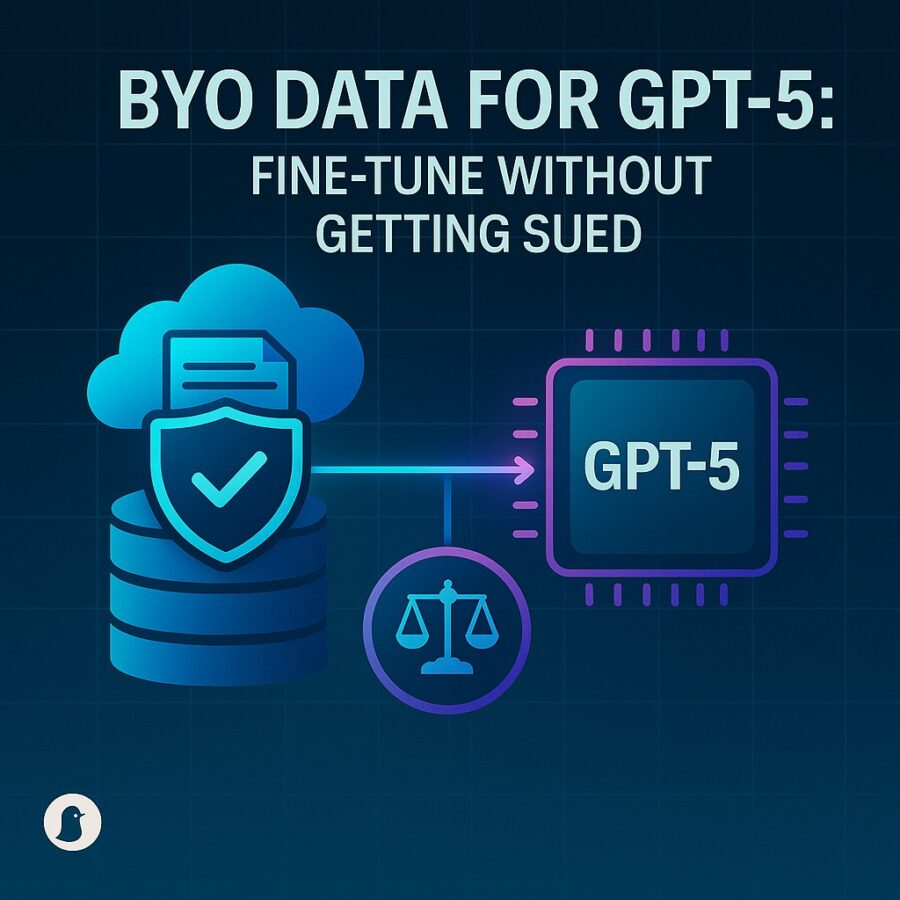
This guide is a practical path for BYO Data For GPT-5: Fine-Tune Without Getting Sued. You will learn what you can customize, what you should avoid, and how to build a simple permission system that keeps your data work useful and defensible.
What “fine-tune” really means for GPT-5 right now
First, an important reality check: OpenAI’s GPT-5 model does not support fine-tuning in the API documentation. (OpenAI Platform)
So how do people “fine-tune” in GPT-5 workflows?
Most of the time, they actually mean one of these:
- Retrieval (RAG): keep your documents outside the model and fetch relevant snippets at runtime.
- Distillation: teach a smaller model to imitate GPT-5 style outputs for a narrower task, which GPT-5 docs list as supported. (OpenAI Platform)
- Fine-tune a different model that supports fine-tuning, then route certain tasks to GPT-5 for reasoning or agent work.
Think of GPT-5 like a high-end chef. You do not surgically rewire the chef’s brain. You adjust the pantry, the recipe cards, and the kitchen routine. If you want a specialist cook for one dish, you train an assistant.
The lawsuit risks you are actually trying to avoid
“Getting sued” usually comes from a few predictable categories, not mystery legal lightning bolts.
Copyright and licensing
If your dataset includes protected work you do not own or license, you may be stepping into infringement claims. Fair use is fact-specific and can be uncertain, especially in AI training contexts. The U.S. Copyright Office has published extensive analysis on generative AI training and how copyright issues show up in that pipeline. (U.S. Copyright Office)
Contracts and confidentiality
Even if something is not copyrighted, you can still be bound by a contract. NDAs, client agreements, and internal policies can forbid reuse.
Personal data and privacy
Customer emails, addresses, health details, payment info, or employee HR material can trigger privacy laws and security duties.
Brand and misrepresentation
If your model outputs text that implies endorsements or invents credentials, you can invite disputes even when the data source was “legal.”
So the goal is not “never take risk.” The goal is to take the kind of risk you can explain to a reasonable person with a straight face.
Build a permission stack before you build a dataset
Here is a simple framework I teach like a lab safety checklist. If any layer fails, do not use the data.
Layer 1: Ownership
Did you create it, and is it yours to reuse?
- Your SOPs, your blog posts, your training slides, your product descriptions: usually yes.
- A client’s documentation: only if the contract says you can.
Layer 2: License
If you did not create it, do you have a license that covers your use?
Creative Commons licenses are common, but they come with terms like attribution, noncommercial limits, or no-derivatives restrictions. (Creative Commons)
Layer 3: Consent and confidentiality
Even with a license, does it contain private or restricted details?
A password list is not “data,” it is a liability.
Layer 4: Purpose fit
Are you using only what you need?
Data minimization is not just a privacy idea. It is a quality idea. Smaller, cleaner datasets reduce weird behavior and reduce legal exposure.
Analogy: you would not pour every chemical in the cabinet into one beaker just because you might need it later. You pick the few compounds that match your experiment.
BYO data sources that usually stay on the safe side
Here are sources that tend to be both practical and defensible, assuming you control them.
- Your own published content (articles, newsletters, scripts)
- Internal SOPs you authored and own
- Support macros and public-facing help articles
- Product manuals you created
- Transcripts from your own training sessions
- Public domain material
- Properly licensed corpora where you follow the license terms
If you use Creative Commons material, do the boring part: document attribution. Creative Commons even offers recommended attribution practices like capturing title, author, source, and license. (Creative Commons)
Data you should treat like a hot stove
- Competitor pages copied into your dataset
- Paywalled courses or ebooks you do not have reuse rights for
- Client documents without explicit permission
- Anything under NDA
- Personal data you do not need
- Medical, financial, or legal records unless you have a compliance program and clear authorization
If you are trying to build a local service “knowledge bot,” you rarely need customer names, addresses, or full invoices. You need the pattern of problems and solutions, not the identity of the person who had the problem.
OpenAI data controls: what changes when you use the API
Many people confuse consumer ChatGPT and the OpenAI API.
OpenAI’s platform documentation states that data sent to the OpenAI API is not used to train or improve OpenAI models by default unless you explicitly opt in. (OpenAI Platform)
OpenAI also describes retention around abuse monitoring logs and typical time windows, with up to 30 days as a default for those logs unless legal requirements apply. (OpenAI Platform)
And on the ownership side, OpenAI’s Terms of Use say you retain ownership of your input and own the output, to the extent permitted by applicable law. (OpenAI)
None of that magically makes your source data “legal.” It simply clarifies what OpenAI does with it, and how long certain logs may be retained.
Think of it like using a rented workshop. The landlord might not claim your tools, but you still cannot bring stolen equipment into the building.
Three customization paths for GPT-5 that reduce legal pain
1) Retrieval: “Use the book, do not photocopy the library”
Retrieval-augmented generation keeps documents in your control and only supplies relevant excerpts to GPT-5 at query time. That lets you:
- Update knowledge without retraining
- Remove documents quickly if a contract changes
- Keep sensitive material behind access controls
- Log exactly what sources were used for an answer
This path is also easier to audit. If a client asks, “Where did that answer come from?” you can point to the chunk.
2) Distillation: “Train a helpful assistant, not the professor”
The GPT-5 model page lists distillation as supported. (OpenAI Platform)
Distillation is powerful when you need:
- A consistent house style for emails or summaries
- Structured outputs for internal workflows
- Lower cost on repetitive tasks
Here is the legal advantage: your training examples can be created from content you own, like your own SOPs and your own successful job tickets, rather than scraped text. That keeps your dataset cleaner and your story simpler.
3) Fine-tune another model, then use GPT-5 as the “override brain”
Fine-tuning is available in the platform, just not on GPT-5 itself. (OpenAI Platform)
A common pattern is:
- Fine-tune a smaller model to do a narrow job (classification, summarization format, templated responses)
- Use GPT-5 for complex reasoning, exceptions, and tool-based workflows
This splits risk: your tuned model handles routine tasks with a controlled dataset, while GPT-5 handles harder cases with retrieval and careful prompting.
The minimum compliance kit you should keep for every dataset
You do not need a corporate compliance department. You do need a one-page record.
Create a simple “Dataset Card” with:
- Dataset name and version
- Purpose (what it is used for)
- Source list (where it came from)
- Rights basis (owned, licensed, consented)
- Exclusions (what you removed and why)
- PII handling method (redaction rules)
- Retention plan (how long you keep raw files)
- Contact person (who can approve changes)
If you ever face a complaint, this card becomes your receipts.
A practical redaction approach that does not destroy usefulness
Redaction fails when it is lazy. It also fails when it is too aggressive.
Aim for this middle path:
- Remove direct identifiers (names, emails, phone numbers, addresses)
- Replace with consistent placeholders ([CUSTOMER_NAME], [ADDRESS])
- Keep the technical detail intact (model numbers, error codes, steps taken)
Analogy: you are grading a student paper. You do not need the student’s home address to evaluate the argument.
How to evaluate for “legal risk signals” before you ship
Run a pre-launch review with three questions:
- Can we explain where the data came from in one sentence?
- Can we prove rights or permission for each source bucket?
- Can we remove a source quickly if asked?
Then test the system for two failure modes:
- Memorization or verbatim regurgitation of source text
- Hallucinated claims about licensing, guarantees, or credentials
If either appears, tighten retrieval, reduce quoting, add refusal behaviors, and improve prompts.
The honest disclaimer that keeps you grounded
This article is practical guidance, not legal advice. If you are building a commercial product, selling a fine-tuned model, or using customer data, a short consult with an attorney can save you from expensive learning.
Still, for most creators and small businesses, the safest approach is consistent:
- Use owned or licensed data
- Keep private details out
- Prefer retrieval over training when in doubt
- Document everything like a lab notebook
That is the real method behind BYO Data For GPT-5: Fine-Tune Without Getting Sued.