Views: 0
Deadlines do not ruin your creativity. Chaos does.
Most creators do not struggle because they cannot write. They struggle because content work is a pile of tiny decisions that show up all at once. What is the angle? What is the structure? What should the reader do next? Which parts need proof? When do you stop polishing?
The cure is not “more inspiration.” The cure is a repeatable prompt stack.
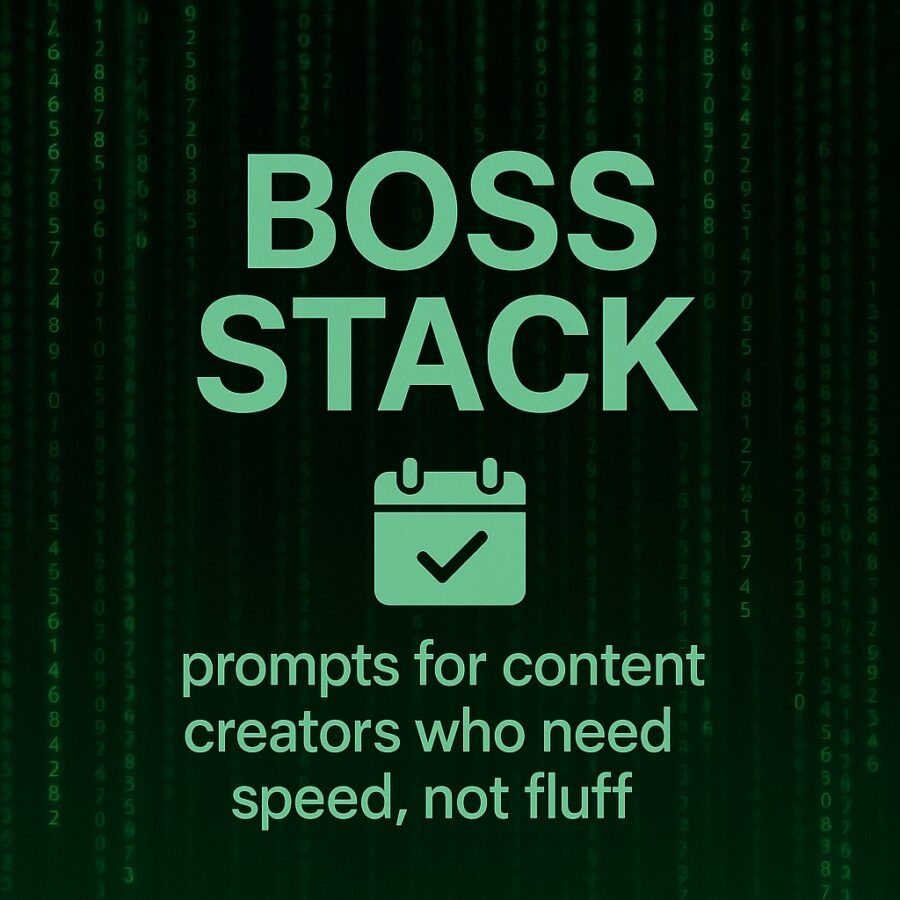
Boss Stack Prompts for Content Creators Who Need Speed, Not Fluff is a practical system: a set of prompts you can run in order to move from idea to publish-ready draft with fewer detours. Think of it like mise en place in a kitchen. You prep the ingredients first, then you cook fast without burning dinner.
This approach also plays nicely with how people actually read online. Users scan web pages instead of reading line by line, so clear headings, short sections, and scannable lists matter. (Nielsen Norman Group)
What “Boss Stack” really means
A Boss Stack is not one mega prompt that tries to do everything. That usually produces a bloated draft.
A Boss Stack is a chain of small prompts, each with one job:
- Clarify the reader’s problem.
- Select an angle that feels human.
- Build a clean outline.
- Draft with a controlled voice.
- Tighten readability.
- Add proof and cut weak claims.
- Package the post for sharing.
OpenAI’s own guidance is blunt about why this works: models respond better when instructions are clear, specific, and supported with context and examples. (OpenAI Platform)
The two rules that make your output feel sharp
Rule 1: Make the model plan before it performs
When you force a brief and outline first, the draft gets calmer. The writing stops bouncing between points. OpenAI’s prompting guides repeatedly emphasize explicit instructions and planning to improve adherence and quality. (OpenAI Cookbook)
Rule 2: Write for scanning, then reward the reader who stays
Jakob Nielsen’s research on web usability shows people scan pages, and that scannable formatting improves usability. (Nielsen Norman Group)
So your draft should be easy to skim, while still giving real value to the person who reads the whole thing.
A quick note on SEO without “SEO brain”
Google’s guidance is simple: make people-first content that is genuinely helpful, and avoid pages made mainly to chase rankings. (Google for Developers)
That does not mean you ignore SEO. It means you use SEO to help a good page get found.
Yoast’s readability analysis is a useful guardrail here, especially for AI-assisted writing. It nudges you toward transition words, shorter sentences, reasonable paragraph length, and fewer passive constructions. (Yoast)
Your Boss Stack Prompts
Each prompt below is built to reduce fluff, improve structure, and keep your voice consistent. Run them in order. If you are in a rush, run prompts 1, 3, 5, and 7 as your “fast lane.”
1) The Brief Builder Prompt
Use this to turn a vague idea into a clear promise.
Prompt: Act as my content strategist. Build a brief for a blog post.
Inputs:
- Working title: [TITLE]
- Target reader: [AUDIENCE]
- Reader problem: [PROBLEM]
- Desired outcome: [OUTCOME]
- Offer or next step: [CTA]
Requirements: - Give me: (1) one-sentence promise, (2) 5 audience pain points, (3) angle options (3), (4) must-include section list (6 to 9 bullets), (5) what to avoid (5 bullets), (6) questions I should answer before publishing (6).
Write in plain English, confident but not salesy.
2) The Angle Filter Prompt
This stops you from writing the same post everyone else wrote.
Prompt: Here is my topic: [TOPIC].
Here is my audience: [AUDIENCE].
Generate 12 angles that are not generic. For each angle, include:
- Hook idea (1 sentence)
- Why the reader cares (1 sentence)
- Unique proof or example I could use (1 bullet)
- Risk of fluff (low, medium, high)
Then recommend the top 3 angles for a useful, people-first article.
3) The Outline Architect Prompt
This creates an outline that is built for scanning.
Prompt: Create an outline for: [TITLE].
Constraints:
- Use H2 and H3 headings.
- Each H2 must answer a real reader question.
- Include a short takeaway line under each H2.
- Keep headings specific and non-clickbait.
- Include sections for: examples, mistakes, and a simple checklist.
Output only the outline with takeaways.
4) The Evidence Finder Prompt
This is your anti-handwaving tool.
Prompt: For this outline: [PASTE OUTLINE]
List claims that require evidence. For each claim, suggest:
- what kind of source would support it (study, official docs, credible expert, dataset)
- what I should search for (exact search phrases)
- what would count as weak evidence
Return as a table with 8 to 15 rows.
5) The Draft Sprint Prompt
This produces the first draft without turning into a wordy lecture.
Prompt: Write the first draft of my blog post using this outline: [PASTE OUTLINE]
Voice: male college professor, direct, friendly, and practical.
Rules:
- Plain English, no corporate jargon.
- Short paragraphs (1 to 3 sentences).
- Vary sentence length, but avoid run-on sentences.
- Use transition words naturally.
- Add one analogy that clarifies the main idea.
- Do not invent facts. If a claim needs a source, mark it as [SOURCE NEEDED].
Output the full draft only.
6) The “Cut Fluff” Editor Prompt
This prompt exists because AI tends to over-explain.
Prompt: Edit this draft for speed and clarity: [PASTE DRAFT]
Goals:
- Remove filler and repeated points.
- Replace vague phrases with concrete ones.
- Convert passive voice to active voice when it improves clarity.
- Shorten long sentences.
- Improve headings for scanning.
Deliverables:
- The edited draft.
- A list of the top 12 edits you made, with a short reason for each.
Yoast’s readability factors map closely to what this prompt does: transition words, sentence length, paragraph length, and passive voice control. (Yoast)
7) The People-First Quality Check Prompt
This aligns your post with Google’s guidance.
Prompt: Review this blog post draft: [PASTE DRAFT]
Score it from 1 to 10 on:
- Helpfulness
- Originality
- Clarity
- Trust (claims and sources)
- Reader experience (scannable structure)
Then answer:
- What would disappoint a real reader?
- What parts feel written for search engines instead of people?
- What needs first-hand detail, examples, or proof?
- What should be removed completely?
Finish by giving me a revised opening paragraph that states the promise clearly.
Google explicitly recommends focusing on helpful, reliable, people-first content and avoiding search engine-first writing. (Google for Developers)
8) The Headline Lab Prompt
Headlines are not decoration. They are navigation.
Prompt: Create 20 headline options for this article: [TITLE + 2-sentence summary]
Rules:
- Avoid hype.
- Make the benefit clear.
- Keep them short and specific.
- Include 5 options that lead with a keyword phrase.
Then choose the top 5 and explain why each works.
Clear, keyword-forward headings help users scan and understand a page quickly. (Nielsen Norman Group)
9) The Hook Generator Prompt
A strong opening is a promise, not a poem.
Prompt: Write 6 different openings for this article: [TITLE]
Each opening must use a different hook style:
- a vivid scenario
- a surprising truth
- a short story
- a blunt statement
- a contrarian angle
- a quick checklist teaser
Keep each opening under 120 words and end with a clear thesis sentence.
10) The “Show Me, Don’t Tell Me” Example Prompt
This turns advice into usable demonstrations.
Prompt: From this article draft: [PASTE DRAFT]
Identify 5 places where I give advice without an example.
For each place:
- write a short example (realistic, specific)
- add a mini before-and-after snippet if relevant
Return the updated paragraphs only.
11) The Social Slice Prompt
This makes promotion painless.
Prompt: Turn this blog post into:
- 6 X posts (each under 240 characters)
- 2 LinkedIn posts (each under 180 words)
- 1 Reddit post that sounds human and invites discussion
- 10 short “quote cards” (1 sentence each)
Rules: no hype, no buzzwords, focus on value and curiosity.
12) The Repurpose Map Prompt
This stretches one article into a week of content.
Prompt: Create a repurpose plan for this article: [PASTE DRAFT]
Output:
- 1 YouTube script outline (6 to 8 minutes)
- 1 email newsletter version (under 500 words)
- 1 checklist or template the reader can download
- 1 FAQ section (8 questions with short answers)
Keep everything consistent with the original voice.
How to run the Boss Stack in 30 minutes
Here is the workflow I recommend when you need speed.
Step A: Lock the promise
Run Prompt 1. Choose one promise sentence. Do not keep shopping.
Step B: Choose an angle that creates contrast
Run Prompt 2. Pick one of the top three angles.
A good angle usually does one of these things:
- It exposes a common mistake.
- It simplifies a messy process.
- It shares a repeatable method.
Step C: Build a scan-friendly outline
Run Prompt 3. Then read the H2s in order. If the sequence feels random, fix it now. Fixing it later costs you time.
Step D: Draft quickly, mark what needs proof
Run Prompt 5. Let [SOURCE NEEDED] markers appear. That is not failure. It is honesty.
Step E: Cut weight, then add proof
Run Prompt 6 to tighten. Run Prompt 4 to find what needs sources. Then patch the draft.
Step F: Do a people-first review
Run Prompt 7. Make the changes. Then stop.
Perfection is not the goal. Publishable and trustworthy is the goal.
The speed trap: why “faster” can still lose
Creators often say they want faster writing. What they really want is faster decisions.
AI can draft quickly, but it can also produce confident nonsense. That is why OpenAI recommends clear instructions and explicit context, rather than hoping the model guesses your intent. (OpenAI Platform)
Speed is only useful when you keep control of:
- Scope: what the post will cover and what it will not.
- Claims: what you can support.
- Voice: what you sound like.
Readability tactics that keep Yoast happy
You do not need to worship a green light, but the checks are practical.
- Use transition words so the reader feels the logic. (Yoast)
- Favor active voice when it improves clarity. (Yoast)
- Keep paragraphs short so scanning does not feel like climbing a wall. (Nielsen Norman Group)
- Break up long runs of text with lists, examples, and subheadings. (Nielsen Norman Group)
Nielsen Norman Group’s guidance is consistent: web writing performs better when it is concise and scannable. (Nielsen Norman Group)
Turning the Boss Stack into income without getting sleazy
If you use AI to make income, you need a clean bridge from value to action.
Here are three simple paths that fit most creators:
Path 1: The “downloadable helper”
Create a checklist, template, or swipe file that matches the post. Offer it as a download. Use your email list to deliver it.
Prompt 12 helps generate the download idea, but you should shape it with real experience. Add the steps you actually use.
Path 2: The “tool plus tutorial”
Write the post as the tutorial. Then recommend the tool you used. This works well with affiliate links, as long as you do not oversell.
A useful rule: mention a tool only after you have taught something that stands on its own.
Path 3: The “mini product upgrade”
End the post with a small next step: a prompt pack, a Notion board, a content calendar, or a workflow guide. Keep it aligned with the article’s promise.
Google’s people-first guidance is a good moral compass here. Your page should help the reader even if they never buy. (Google for Developers)
Common mistakes that create fluff
Fluff often hides behind polite language. Here are the usual culprits:
- Stating the obvious for multiple paragraphs.
- Using abstract nouns instead of concrete examples.
- Giving advice without a step-by-step.
- Repeating the same idea with slightly different wording.
- Adding “background” that does not help the reader act.
Prompt 6 is your vacuum cleaner. Use it aggressively.
A simple checklist before you hit publish
Read this out loud. If you stumble, revise the sentence.
- The first 120 words state the promise.
- Each H2 answers a real question.
- At least one example shows the method in action.
- Claims are supported, or they are softened and labeled.
- The post is easy to scan in under 30 seconds.
- The call to action is helpful, not pushy.
That is the whole game: clarity, proof, and momentum.
Wrap-up: speed that still respects the reader
The point of Boss Stack Prompts for Content Creators Who Need Speed, Not Fluff is not to replace your brain. It is to protect your attention.
You cannot control the internet’s noise, but you can control your process. A prompt stack turns writing into a series of clean, manageable moves. That is how you publish more without sounding hollow.
If you build the habit, your best work shows up more often, and it shows up on time.