Views: 3
A blank document is not scary because you lack ideas. It is scary because it asks you to make fifty decisions at once. Topic, angle, audience, structure, tone, evidence, and polish all show up at the same time.
The trick is to separate those decisions into stages, then let one well-built prompt walk you through them. This matters if you use AI to make income, because speed only helps when the output stays trustworthy and readable.
Why One Prompt to Brief, Outline, Draft, and Edit any Blog Post works
Good writing is a sequence of small moves. First you define the question you are answering. Next you choose the order that will make sense to a reader. Then you draft, and only after that do you tighten and correct.
Search engines reward this kind of clarity, too. Google advises creators to focus on helpful, people-first content that demonstrates experience and expertise, not pages produced only to rank. (Google for Developers)
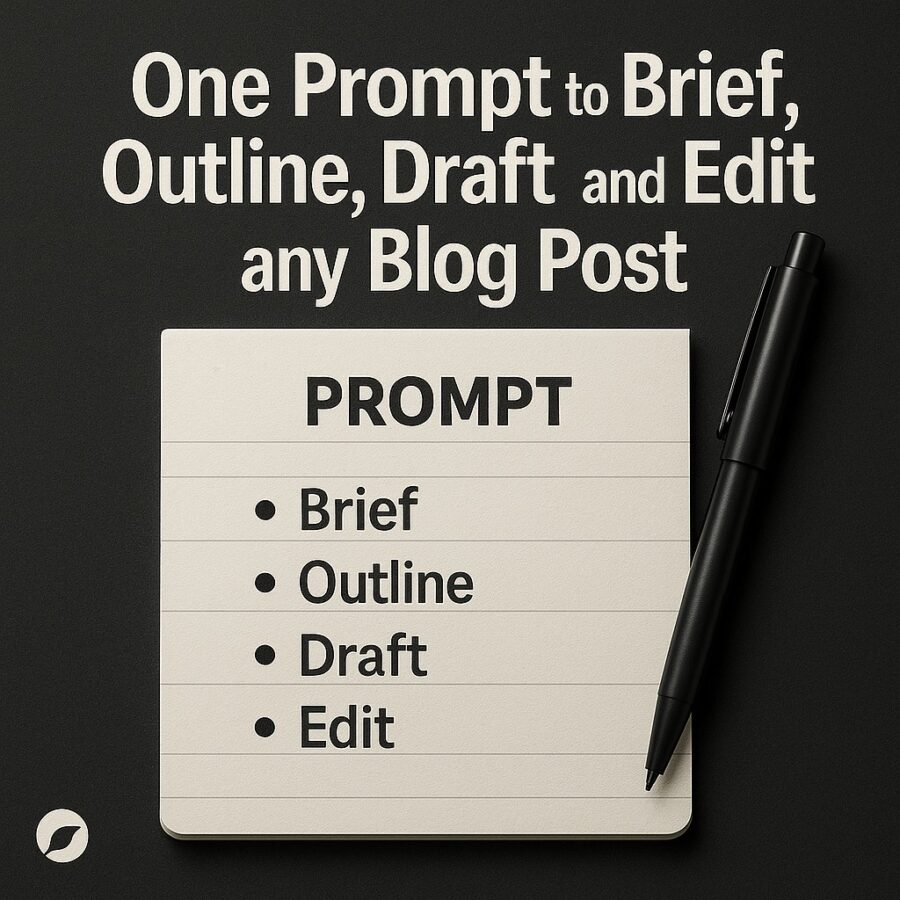
In other words, you want a system that helps you think before you type. A single prompt can do that by forcing four deliverables in one pass: a brief, an outline, a draft, and an edit.
The rules your prompt should enforce
Before you paste any prompt into ChatGPT, decide what you refuse to compromise on. Here are five constraints that reliably improve results:
- People-first aim: solve a real reader problem, not a keyword target. (Google for Developers)
- Readability: short paragraphs, clear transitions, and limited passive voice. (Yoast)
- Verifiable claims: separate facts from opinions, and cite sources for facts.
- Consistent voice: choose one tone and keep it steady.
- One job per section: brief first, outline second, draft third, edit last.
Yoast’s readability analysis highlights the issues most AI drafts struggle with, especially transition words, sentence length, and passive voice. (Yoast)
Copy this One Prompt to Brief, Outline, Draft, and Edit any Blog Post
Paste the prompt below into ChatGPT. Replace the bracketed fields. If you do not know an answer, write “unknown” and the prompt will make a reasonable assumption.
Prompt: You are my blog post engine. Your job is to brief, outline, draft, and edit ONE blog post in a single response.
INPUTS
- Working title: [TITLE]
- SEO keyphrase (must appear exactly as written): One Prompt to Brief, Outline, Draft, and Edit any Blog Post
- Topic summary in 2 sentences: [TOPIC]
- Target reader: [AUDIENCE]
- Reader intent (learn, compare, buy, fix): [INTENT]
- Brand voice: friendly male college professor, plain English, no corporate jargon
- Length target: about [WORD COUNT] words
- Must include: [EXAMPLE], [1 to 3 DATA POINTS], and at least [2] credible citations
- Must avoid: run-on sentences, fluff, em dash symbol, and unverified claims stated as fact
PROCESS
- BRIEF: Create a tight brief with audience pain points, promise, angle, and a list of subtopics. Add assumptions if inputs are missing.
- OUTLINE: Create an H2 and H3 outline that matches the brief. Each section must have a clear takeaway.
- DRAFT: Write the full article with short paragraphs and natural transitions. Use dependency style sentences where possible: clear subject, clear verb, clear object.
- EDIT: Revise your own draft using readability principles: add transition words, reduce passive voice, shorten long sentences, and improve scannability with subheadings and bullets. Use Yoast-style readability ideas as your checklist.
OUTPUT FORMAT
A) Brief
B) Outline
C) Edited Draft
D) Edit Report: list the top 10 changes you made and why
E) SEO Pack: meta description (155 characters max), slug, and 8 tags
How to use the prompt without fighting it
A prompt like this behaves best when you treat it like a form, not a magic spell.
- Fill the title and audience first. Those two choices shape everything else.
- Write a two-sentence topic summary that includes a concrete outcome.
- Add one example you can stand behind. Your own experience counts. If you lack that, use a public case study and cite it.
- Provide one to three data points. They can be survey stats, platform metrics, or cost comparisons, as long as you can cite them.
When you keep inputs small and specific, the model wastes less energy guessing.
Editing standards that keep you out of trouble
AI writing fails in two predictable ways: it gets vague, or it gets overconfident. Your edit pass should attack both.
First, tighten readability. Tools like Hemingway score your text and flag hard-to-read sentences, which helps you keep paragraphs digestible for real people. (Hemingway App)
Second, protect trust. Google’s guidance on helpful content is blunt about the goal: content should benefit people, and it should reflect real expertise. (Google for Developers)
A simple, repeatable checklist works:
- Every section answers a question a reader actually has.
- The first paragraph states the promise of the post.
- Each H2 earns its spot by adding a new idea.
- Any statistic has a source.
- Any claim that sounds like a fact gets verified or softened.
A quick example for income-focused creators
Suppose you want a post that sells a digital template. The prompt can produce the post, but you still decide the product hook.
In the inputs, set intent to “buy” and include your offer as the example. Then ask for a short call to action that feels like advice, not a pitch. Finally, add a credibility line, such as a brief note about the workflow you tested.
That is how you use AI to make income without turning your blog into a robot diary.
Close with a system, not motivation
Motivation fades. Systems stay.
The value of One Prompt to Brief, Outline, Draft, and Edit any Blog Post is not that it writes for you. It is that it forces you to think in stages, then produces a clean draft you can publish.
Use it twice and you will notice something. The prompt does not replace your judgment. It protects it.