Views: 0
Most people do research the way they clean a garage. They grab the first box they see, open it, get distracted by a mystery cable, and suddenly an hour is gone.
AI can make that worse, because it can hand you a smooth paragraph that feels finished even when the reasoning is thin. What you need is not “more output.” You need a map.
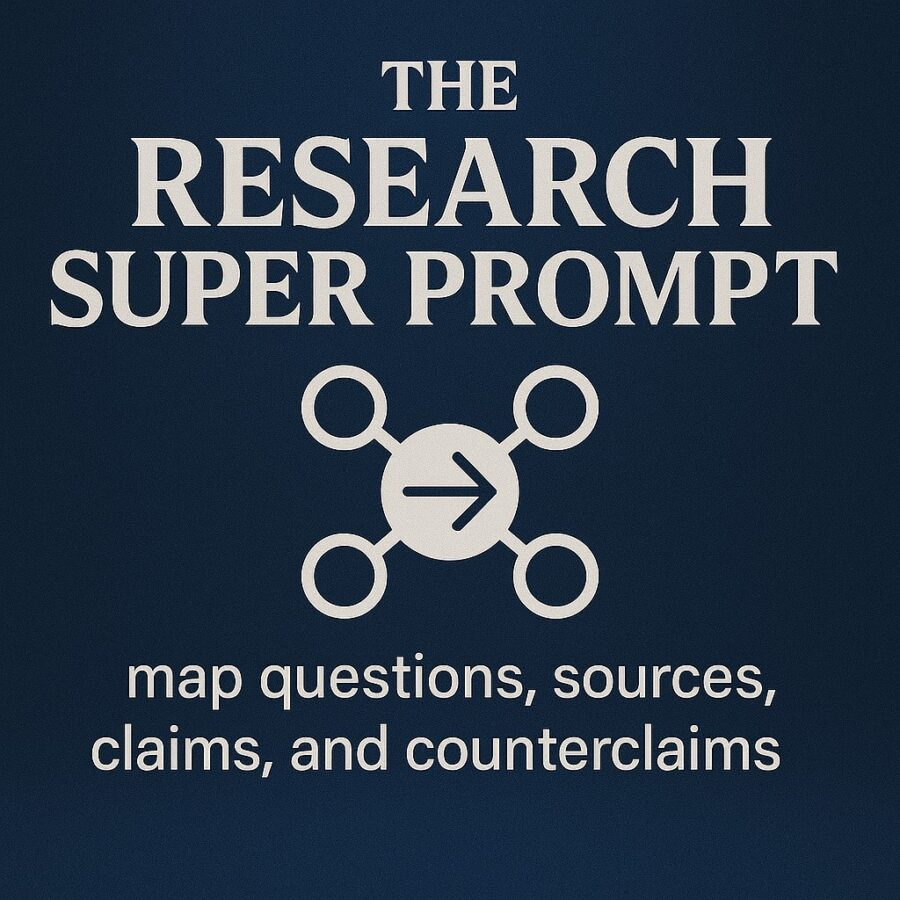
That is exactly what The Research Super Prompt: Map Questions, Sources, Claims, & Counterclaims is built to do. It forces your research into four containers:
- the questions you are actually trying to answer
- the sources that deserve your attention
- the claims you are allowed to make
- the counterclaims you must take seriously
If you publish content, build digital products, or earn affiliate income, this approach keeps you honest and fast at the same time.
Why The Research Super Prompt: Map Questions, Sources, Claims, & Counterclaims matters
Research is not a straight line. It is inquiry. You start with a hunch, you test it, you revise, and you keep moving. The American Library Association’s information literacy framework puts this plainly by framing research as inquiry and scholarship as a conversation, not a single answer hunt. (American Library Association)
When you skip that mindset, two bad things happen:
- You confuse “I found something” with “I proved something.”
- You publish claims that collapse the second someone asks, “According to who?”
The goal is not to sound smart. The goal is to build a trail a reader can follow.
The simplest analogy: research is a detective board, not a bucket
Imagine a detective board on the wall. You have photos, dates, and notes pinned up. There are strings connecting what supports what.
That is research done correctly.
Most people, by contrast, use a bucket. They toss links in and hope the bottom of the bucket becomes truth. It does not.
Your AI prompt should force the detective board.
Step 1: Map the questions before you touch sources
Good research starts by narrowing the problem. If your question is vague, your sources will be random, and your writing will wander.
Build a “question ladder”
Start with one big question, then break it down into smaller questions that are easy to verify.
Big question: What am I trying to decide or explain?
Support questions:
- What terms do I need to define?
- What evidence would change my mind?
- What are the strongest competing views?
- What would a skeptical reader ask?
This is how you avoid the classic trap: collecting facts that do not actually answer the question.
Step 2: Use a real source evaluation method, not vibes
Online research punishes trust and rewards verification. That is why professional fact checkers rely on habits like lateral reading and quick source checks.
Lateral reading in plain language
Lateral reading means you leave the page and open new tabs to see what other credible sources say about that site, author, or claim. The Civic Online Reasoning curriculum teaches this approach explicitly: do not stay trapped inside one webpage. Step out and check who is behind it. (cor.inquirygroup.org)
The SIFT method as a quick routine
SIFT is a practical checklist for judging online information:
- Stop
- Investigate the source
- Find better coverage
- Trace claims, quotes, and media back to the original context (Chicago Library Guides)
If you do nothing else, do SIFT. It reduces the “shared screenshot of a screenshot” problem that wrecks credibility.
The CRAAP test for academic style evaluation
CRAAP is a classic rubric for evaluating information using:
- Currency
- Relevance
- Authority
- Accuracy
- Purpose (library.csuchico.edu)
SIFT is fast. CRAAP is thorough. You can use both depending on the stakes.
Step 3: Turn claims into a structure you can test
This is where research becomes writing.
A claim is not “something I read.” A claim is a statement you are willing to stand behind, with support.
The Toulmin model as your claim blueprint
The Toulmin approach breaks an argument into parts like claim, grounds (evidence), warrant (why the evidence supports the claim), plus qualifiers and rebuttals. Purdue OWL summarizes these components clearly. (Purdue OWL)
Here is the key lesson: most claims need qualifiers.
If your writing is full of “always” and “never,” your research is probably weak, or your tone is too confident.
Claim, Evidence, Reasoning, and rebuttal
Another helpful classroom framework is Claim, Evidence, Reasoning, often extended with Rebuttal. The National Science Teaching Association describes how adding a rebuttal helps students deal with alternative explanations. (nsta.org)
That matters for business content too, because readers trust you more when you address the strongest counterpoint.
Step 4: Counterclaims are not enemies, they are quality control
A counterclaim is not a “hater opinion.” It is the strongest competing explanation.
If you can handle it fairly, you look credible.
If you ignore it, you look like you are selling something.
Counterclaims do three useful jobs:
- They reveal missing evidence.
- They prevent overconfident conclusions.
- They give you better writing, because your argument gains shape and tension.
Step 5: Use The Research Super Prompt to build the map
Now we put it all together.
This super prompt is designed for content publishing and digital products, with global audiences. It will generate:
- a question map
- a source plan
- a claim ledger
- a counterclaim ledger
- a verification checklist
Prompt: You are my research coach and editorial fact checker. Task: Build a research map for this topic: [TOPIC]. Audience: [WHO THIS IS FOR]. Goal: [WHAT I NEED TO DECIDE OR EXPLAIN]. Constraints: Use plain English. Keep it practical. Do not invent facts or citations. If you are unsure, label it as unknown and ask for what to verify next. Use SIFT and lateral reading habits for web sources. Output the following sections in order: (1) Question Map: one main question plus 8 to 12 subquestions, grouped by theme. (2) Source Plan: list 10 to 15 source types to seek (primary, official docs, peer reviewed, reputable reporting, industry data). For each, explain what it can confirm or falsify. (3) Claims Ledger: propose 6 to 10 candidate claims I might make. For each claim, add: required evidence, what would weaken it, and a confidence placeholder (low, medium, high). (4) Counterclaims Ledger: list the strongest competing claims, with what evidence would support them. (5) Verification Steps: a checklist to validate sources and trace key claims back to originals. (6) Writing Blueprint: suggested outline that fairly presents claims and counterclaims, and ends with a careful, qualified takeaway. Before you begin, ask me 5 clarifying questions, including jurisdictions or regions involved and what sources I already have.
This prompt forces the model to behave like an instructor and a skeptical editor, not a hype machine.
Step 6: Feed it sources in controlled batches
Here is the practical workflow I teach students, and it works beautifully for creators.
Batch A: Your baseline sources
Give the model 3 to 5 links or excerpts you already trust.
Ask it to:
- summarize what each source actually claims
- extract the data points you can cite
- list what each source cannot prove
Batch B: Your “better coverage” sources
This is the SIFT move that saves you. Ask for 3 independent sources that confirm or challenge the same key claim. (Chicago Library Guides)
Batch C: Primary sources
Whenever possible, find the original report, dataset, policy, or documentation.
Then ask the AI to trace claims back to the original context, which is also a core SIFT step. (clark.libguides.com)
Step 7: Convert the map into content that reads well
Many research-backed articles fail because they feel like a bibliography.
The trick is to write like a teacher:
- define terms
- show examples
- anticipate objections
- summarize what is solid and what is uncertain
A clean structure that fits Yoast style
Use short paragraphs and clear headings:
- Problem and why it matters
- Definitions and scope
- What the best sources say
- Key claims and evidence
- Counterclaims and why they exist
- What we can conclude, with qualifiers
- What to do next
The ACRL framework’s idea that scholarship is a conversation fits nicely here. You are showing the conversation, not pretending you ended it. (American Library Association)
A worked mini example
Let’s say your topic is: “Do affiliate disclosures reduce conversion?”
Question map sample
- What counts as a disclosure for each platform?
- Where do readers notice it most?
- What evidence exists about trust and conversion?
- What industries behave differently?
Claims ledger sample
- Claim: Clear disclosures can increase trust and reduce refunds.
- Evidence needed: A/B tests, platform guidance, case studies.
Counterclaim sample
- Counterclaim: Disclosures reduce clicks for impulse buyers.
- Evidence needed: A/B tests on high intent versus low intent traffic.
Notice what is happening: you are no longer guessing. You are building a testable argument.
Common mistakes The Research Super Prompt prevents
Mistake 1: Confusing summaries with evidence
A blog post summarizing another blog post is not strong support.
Mistake 2: Publishing universal claims without scope
If your research is US-focused, do not write like it applies everywhere.
Mistake 3: Ignoring counterclaims
Toulmin includes rebuttal for a reason. Strong arguments acknowledge exceptions. (Purdue OWL)
Mistake 4: Not checking who is behind a source
Lateral reading exists because “professional looking” does not equal “reliable.” (cor.inquirygroup.org)
A quick add-on prompt for claim checking
Use this after you draft a section. It catches the “sounds true, might be wrong” problem.
Prompt: Act as a skeptical reviewer. Scan this draft for factual claims, numbers, and cause-effect statements. Output a table with: claim, type (fact, interpretation, advice), evidence needed, and risk level. Then rewrite any high-risk sentences to be more careful and qualified. Draft: [PASTE TEXT].
A quick add-on prompt for counterclaim hunting
This is how you avoid one-sided writing.
Prompt: Find the strongest counterclaims to my position and present them fairly. For each counterclaim, list what evidence would support it, what evidence would weaken it, and which subquestion it answers. Then suggest how to address it in one paragraph without sounding defensive. Topic: [TOPIC]. My current stance: [STANCE].
Wrap-up
The best research is not the biggest pile of links. It is a clear chain from question to source to claim, with honest counterclaims.
The Research Super Prompt: Map Questions, Sources, Claims, & Counterclaims gives you that chain. It is a repeatable way to turn AI into a research assistant that helps you think, not just type.
Use it for blog posts, product guides, affiliate comparisons, and even policy pages. Your readers will feel the difference, because your writing will have backbone.