Views: 0
If you have ever graded a student’s essay that sounded brilliant but answered the wrong question, you already understand why prompts fail in the real world. The words look confident. The paragraphs are smooth. Then you notice the quiet problem hiding underneath: the output is not dependable, not usable, or not traceable.
That is why the SEO keyphrase The AAA Test: Accuracy, Actionability, Accountability for Every Prompt matters. It is a simple way to stop trusting vibes and start checking results.
The trick is to treat a prompt like a lab procedure, not a wish. In a lab, you do not just “mix stuff” and hope. You confirm the measurements, write down your steps, and make it possible for someone else to reproduce what you did. Prompting works the same way, especially because model outputs can vary from run to run. OpenAI’s evaluation guidance exists for exactly this reason: you need repeatable tests, not one lucky sample. (OpenAI Platform)
What the AAA Test is
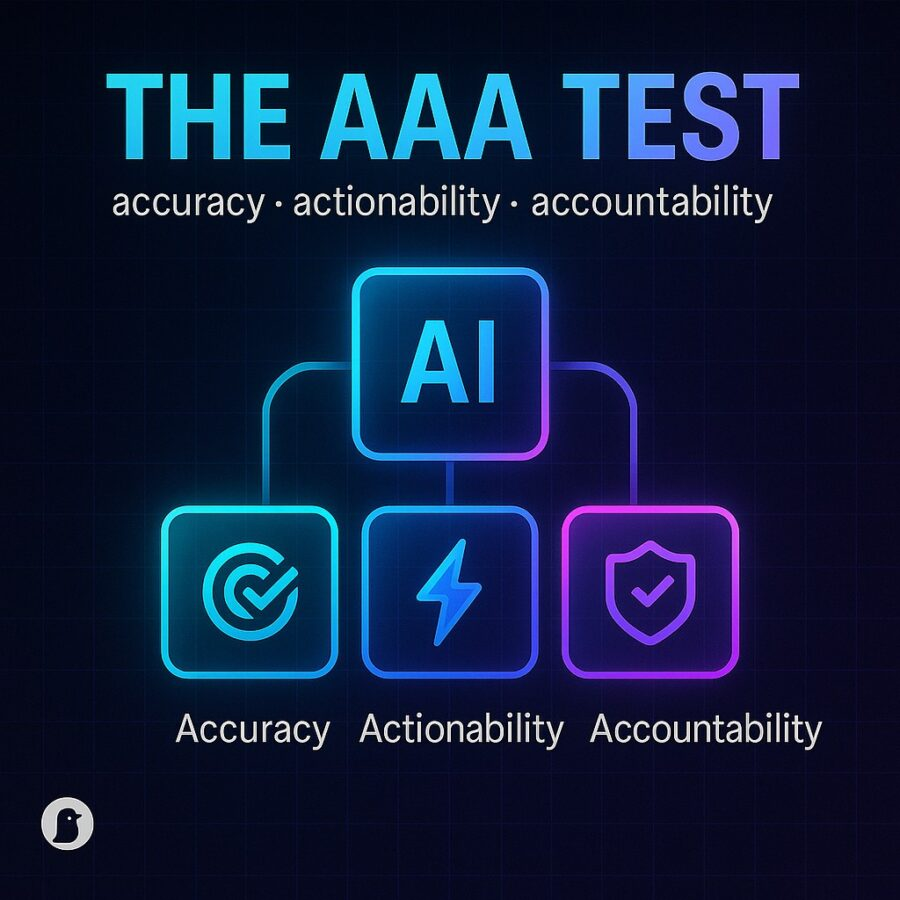
The AAA Test is a three-part quality check you run on any prompt before you rely on it for publishing, client work, automation, or products.
Accuracy asks: Is it correct and grounded, or is it polished nonsense?
Actionability asks: Can a real person follow it and get a result, or is it vague inspiration?
Accountability asks: Can you track how the output was produced, what assumptions were made, and who is responsible for decisions?
You can think of it like a tripod. Take away one leg and the whole setup wobbles.
A is for Accuracy: “true, checkable, and not pretending”
Accuracy is not perfection. It is honesty, verification, and sensible limits.
A prompt tends to fail the Accuracy test in three predictable ways:
- It invites hallucinations by requesting specifics without sources.
- It mixes facts with guesses without labeling uncertainty.
- It hides errors inside confident language.
If you want a practical method to reduce hallucinations, the research behind Chain-of-Verification is worth knowing. The idea is simple: draft first, then generate verification questions, answer them independently, then revise. That extra step measurably reduces hallucinations across tasks in the authors’ experiments. (arXiv)
Accuracy checks you can apply in under two minutes:
- Ask for a “claims list”: every factual claim as a bullet.
- Require a confidence label for each claim (high, medium, low).
- Force verification: “If you cannot verify, soften or remove.”
One more reality check: you will not eliminate hallucinations completely. Multiple credible reports and researchers point out that these models generate text probabilistically, so errors remain a persistent risk, especially when users treat fluent writing as proof. (Financial Times)
Affiliate Link
See our Affiliate Disclosure page for more details on what affiliate links do for our website.

A is for Actionability: “a reader can do something with this”
Actionability is where many prompts quietly die. The model gives a nice explanation, but the user cannot apply it.
To pass Actionability, the output needs three ingredients:
Clear steps. “Do X, then Y, then Z.”
A defined finish line. “You are done when you have A and B.”
Constraints that match reality. Time, budget, tools, audience.
If you publish content or sell AI workflows, actionability is the difference between “interesting post” and “I used this and it worked.”
A good benchmark is rubric-based evaluation. Instead of arguing about whether something is “good,” you score it against criteria like completeness, specificity, and clarity. Rubric evaluation has become a common approach in prompt evaluation writeups because it turns taste into checkable requirements. (Weights & Biases)
Quick Actionability checks:
- Can I follow this in 10 minutes without guessing?
- Does each step include an input and an output?
- Are there examples, not just advice?
A is for Accountability: “someone can audit this later”
Accountability sounds formal, but it is actually simple: can you explain what happened, and can you repeat it responsibly?
If you are using AI for income, accountability protects you when:
- a client asks, “Why did you recommend this?”
- a reader says, “That claim is wrong, where did it come from?”
- you need to update a workflow and compare versions.
This connects nicely to the NIST AI Risk Management Framework, which emphasizes governance practices, documentation, and risk management across an AI system’s lifecycle. NIST frames accountability as part of building trustworthy AI, including the need to manage and communicate risk. (NIST)
Accountability checks you can apply immediately:
- Version your prompt. Even “v1.3” in the title helps.
- Record your inputs. What data did you supply, and what did you exclude?
- Record assumptions. If you guess, admit it.
- Keep a change log. What changed, and why?
This is not busywork. It is the difference between a hobby prompt and a professional tool.
Affiliate Link
See our Affiliate Disclosure page for more details on what affiliate links do for our website.
This offer is for NEW USERS to Coinbase only!

Alt+Penguin’s Referral link details for NEW Coinbase users
When using our referral link (click here or the picture above) and you sign-up for a NEW Coinbase account & make a $20+ trade, you will receive a FREE $30 to your Coinbase account!
The AAA Scorecard: a fast way to grade any prompt
Use a 0–2 score for each category.
Accuracy
0 = makes claims with no grounding or clarity
1 = mostly correct but has unverified spots
2 = separates facts from uncertainty, includes checks
Actionability
0 = vague, no steps, no finish line
1 = steps exist but missing details or examples
2 = clear steps, outputs, constraints, and examples
Accountability
0 = no traceability, no assumptions listed
1 = partial traceability, inconsistent documentation
2 = versioned, assumptions logged, outputs reproducible
A perfect prompt scores 6 out of 6. A prompt you can still use safely might score 4 or 5, depending on the risk level of the task. For medical, legal, or financial topics, you should be stricter.
A practical workflow: build AAA into your writing and products
Here is a clean pipeline that works for creators and small businesses.
Step 1: Draft output
Get a complete first response.
Step 2: AAA Audit
Run the scorecard, then request fixes for anything below 2.
Step 3: Verification pass
Use a verification method for factual claims, similar in spirit to Chain-of-Verification. (arXiv)
Step 4: Evaluate like software
Treat your prompt like a product feature. Run it on a small set of test inputs and look for failures. This is the core logic behind model evals and prompt evaluation frameworks: you measure behavior across examples, not one demo. (OpenAI Platform)
If you want to go deeper, recent work like ResearchRubrics shows how detailed rubrics can be paired with realistic prompts to evaluate qualities like grounding, completeness, and clarity. That is basically AAA with a microscope. (arXiv)
Two reusable “AAA meta prompts” you can paste today
Use these when you want the model to help you enforce the AAA Test.
Prompt: You are my AAA Prompt Auditor. Evaluate the following prompt and its output. Score Accuracy, Actionability, and Accountability from 0–2 each. For each score, list specific reasons and propose exact edits to the prompt that would raise the score. Then rewrite the prompt as v2 with those improvements. Prompt and output: [PASTE].
Prompt: Run a verification pass on the draft below. Step 1: list factual claims. Step 2: write verification questions for each claim. Step 3: answer the verification questions without referencing the draft. Step 4: rewrite the draft, removing or softening anything you could not verify. Draft: [PASTE].
These two prompts are not fancy, but they are powerful because they force the model to stop improvising and start checking.
How AAA helps you make money with AI without wrecking trust
For blog posts: AAA reduces “pretty but wrong” sections that damage reader confidence. Accuracy prevents nonsense. Actionability increases shares because readers can use it. Accountability helps you update posts and keep them consistent.
For prompt packs and templates: AAA makes your product feel tested. People pay for reliability. A template that includes steps, examples, and clear outputs is easier to sell than a vague list of ideas.
For client deliverables: AAA gives you a professional standard. You can tell a client, “We run an Accuracy, Actionability, Accountability check on every workflow.” That sentence signals responsibility without any buzzwords.
And if you ever build agents or automations, AAA becomes the difference between a cute demo and something you can hand to a customer without sweating.
Affiliate Link
See our Affiliate Disclosure page for more details on what affiliate links do for our website.

A short checklist you can print and tape near your desk
Accuracy
- Claims listed and labeled by confidence
- Verification questions generated
- Unverified items softened or removed
Actionability
- Steps include inputs and outputs
- Constraints are explicit
- One example included
Accountability
- Prompt versioned
- Assumptions logged
- Test cases saved for regression checks
If you do this consistently, your prompts stop being one-off tricks and start acting like a system.