Views: 0
A “prompt pack” sounds cute until you watch a real business try to use one.
A shop owner opens a generic prompt bundle, scrolls past “write me a viral post,” and closes the tab. Not because AI is useless. Because the prompts ignore the messy, specific reality of work. The language of a dispatcher. The checklist a foreman needs. The way a receptionist calms an upset caller.
That is where you win.
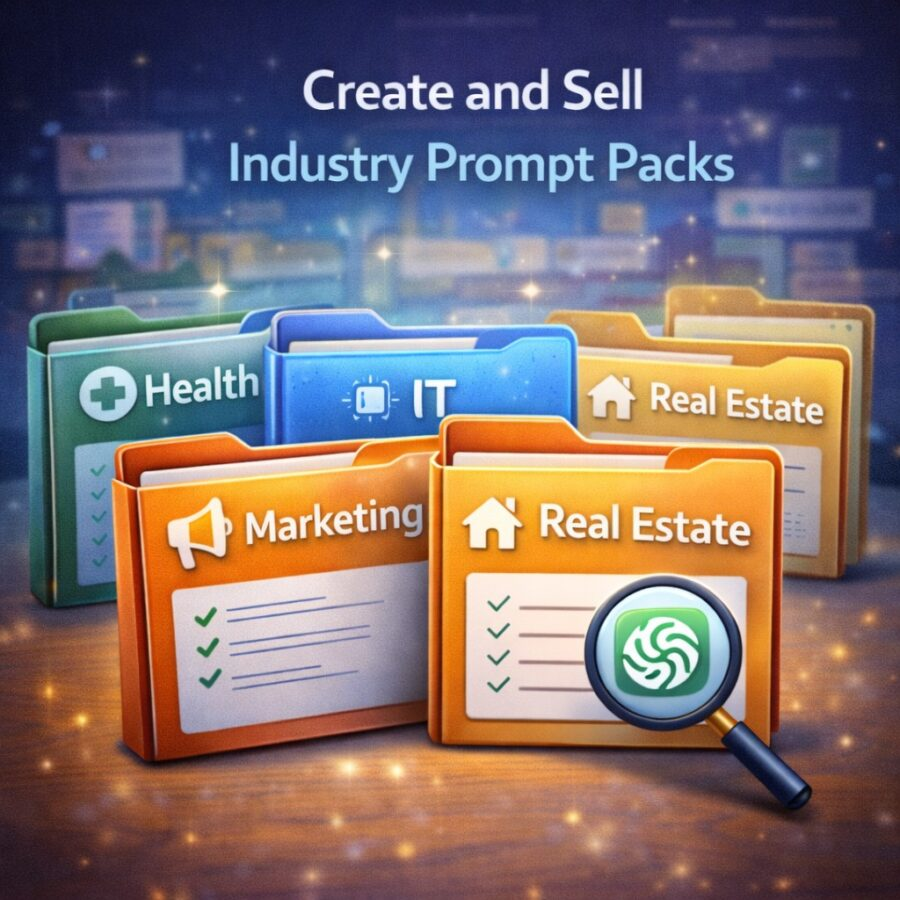
When you Create and Sell Industry Prompt Packs, you are not selling words. You are selling time, confidence, and a clearer next step for someone who is busy and tired. That is why industry packs can outperform generic “content prompts,” especially as AI becomes normal in day to day operations. McKinsey’s 2025 reporting shows widespread AI usage across organizations, and Stanford’s AI Index points to growing adoption and investment momentum. (McKinsey & Company)
Why Create and Sell Industry Prompt Packs instead of generic prompt lists
Generic prompt lists are like giving everyone the same wrench and calling it a toolbox.
Industry packs work because they focus on outcomes tied to real roles. In plain terms, they help people do their job better.
Examples:
- A property manager who needs tenant email templates that do not escalate conflict.
- A home services technician who must write clean service notes fast.
- A small medical office that needs phone scripts and follow up messages without sounding like a robot.
Businesses will pay for that practicality because AI adoption is rising, but execution is uneven. The gap between “we use AI” and “we use AI well” is where your product lives. (McKinsey & Company)
What makes an industry prompt pack “real”
If you want to Create and Sell Industry Prompt Packs that actually get used, each prompt must have four traits.
First, it has a clear job to do.
Second, it includes the inputs the user already has.
Third, it demands a structured output.
Fourth, it includes a quality check so the user is not trusting a first draft.
This is also why prompt marketplaces tend to reject vague prompts with no clear use case. Even marketplaces that monetize prompts emphasize value and use case in their submission rules. (promptbase.com)
So your pack is not “100 prompts for dentists.” It is “the 12 prompts a dental office will run every week.”
Pick industries where the pain is obvious
Choosing the right niche is half the work. The easiest industries to serve have three qualities:
- Repetitive communication (calls, texts, emails, quotes, follow ups)
- Document heavy workflows (forms, reports, tickets, notes)
- High cost mistakes (misquotes, compliance issues, bad handoffs)
Strong candidates:
- Trades and home services
- Real estate and property management
- IT support and managed services
- Insurance agencies
- Bookkeeping and tax prep
- Recruiting and staffing
- Local clinics and wellness practices
If you are unsure, look for roles where people reuse templates already. That is a blinking neon sign that prompts will fit.
The research method that builds prompts people trust
You do not need to be a 20 year veteran of an industry. You need to understand their paperwork, their deadlines, and their typical stress.
Here is a clean way to gather that without guessing:
- Collect public artifacts
Job descriptions, intake forms, client questionnaires, SOP snippets, and any onboarding docs you can find. - Mine real questions
Search Reddit, Facebook groups, and niche forums for “how do you handle” threads. Those reveal the language people actually use. - List the top 25 recurring tasks
Not “marketing.” More like “reply to a customer asking for a refund,” or “turn bullet notes into a service report.” - Define success for each task
What does “good” look like? Short, clear, compliant, friendly, persuasive, or all four.
This method is boring, which is exactly why it works.
The prompt formula that scales across industries
When you Create and Sell Industry Prompt Packs, consistency is your friend. Use a standard skeleton, then tailor the details.
A strong “real job” prompt usually includes:
- Role: who the AI is pretending to be
- Context: the situation and audience
- Inputs: what the user will paste in
- Constraints: tone, length, rules, what to avoid
- Output format: bullets, table, email, script, checklist
- Quality check: self review steps or a rubric
This structure reduces “AI surprise,” which is where users lose confidence.
Affiliate Link
See our Affiliate Disclosure page for more details on what affiliate links do for our website.

Three examples to prove you mean “real prompts for real jobs”
These are short samples. In your paid pack, each prompt should come with a one line use case, a sample input, and a sample output.
Prompt: You are a home services technician writing a service summary for the customer and a separate internal note for the office. Use my job notes. Output two sections: (1) Customer Summary in plain language, 120 to 160 words. (2) Internal Note with parts used, time on site, follow up needed, and any safety issues. Ask me 3 questions if info is missing.
Prompt: You are a property manager responding to a tenant complaint about noise. Write a calm, firm reply that acknowledges the issue, explains the next steps, and requests any missing details. Keep it under 180 words. Include a short bullet list of what the tenant should provide. Avoid legal threats.
Prompt: You are an IT support dispatcher. Turn this messy ticket into a clean summary for the technician. Output: problem statement, environment, steps already tried, urgency, and first 3 troubleshooting actions. Keep it crisp. Do not invent details. If something is unclear, mark it as “needs confirmation.”
Notice what these do. They reduce the “blank page” feeling. They also prevent AI from pretending it knows facts it was never given.
Package design that makes buyers feel safe on Day 1
Most prompt packs fail because the buyer does not know where to start. Fix that with a layout that feels guided.
A simple industry prompt pack can include:
- Start Here page with a 5 minute setup
- Prompt map: “use these for sales,” “use these for ops,” “use these for customer care”
- Prompt cards with fill in fields like [CUSTOMER NAME] and [POLICY]
- Output examples so buyers know what “right” looks like
- A troubleshooting page: what to do when output is too long, too bland, or too confident
This is the same reason people love templates. Ahrefs publicly shares content marketing templates because structured starting points speed up work and reduce errors. Your pack applies that same “template logic” to prompts. (Ahrefs)
Where to sell and how to position it
You have three lanes, and each supports the others.
Lane 1: Your own website
Highest control, best long term brand value. Shopify notes that digital products can be created once and sold repeatedly, which is exactly the economics you want. (Shopify)
Lane 2: Marketplaces
PromptBase is one example of a marketplace built around buying and selling prompts. It signals demand and gives you distribution. (promptbase.com)
Lane 3: B2B direct outreach
This is underrated. A pack built for “HVAC service advisors” can sell faster via direct outreach than by hoping strangers browse a marketplace.
Positioning tip: name the job, not the industry.
“Prompt Pack for Dental Offices” is broad.
“Front Desk Prompt Pack for Dental Offices” feels like a tool.
Affiliate Link
See our Affiliate Disclosure page for more details on what affiliate links do for our website.

Pricing that does not feel like a gamble
When people buy prompts, they fear wasting money on fluff. Your pricing should match the risk level.
A clean model:
- Starter pack: $19 to $39, 15 to 25 prompts, one role
- Team pack: $49 to $99, 40 to 80 prompts, 2 to 3 roles, includes examples
- Pro kit: $149 to $299, role bundles plus onboarding, plus update access
If you want faster conversions, offer a small free sample. For example, three prompts and one “prompt map” page.
The upgrade path that turns prompt packs into recurring income
The title is about creating and selling prompt packs, but the long game is retention.
Here are three recurring offers that pair naturally once you Create and Sell Industry Prompt Packs:
- Monthly prompt maintenance
Industries change. Software changes. Processes change. Your updates keep the pack relevant. - New prompt drops
Add 5 prompts per month tied to seasonal needs, new regulations, or common customer scenarios. - Customization retainer
For a higher price, you adapt prompts to the client’s exact SOPs, brand voice, and tools.
This is how “one time digital product” turns into “predictable monthly revenue.”
Legal and safety basics you should not ignore
You do not need to be dramatic, but you do need boundaries.
Include a short disclaimer:
- Prompts are educational and operational aids
- Outputs must be reviewed by a human
- Not legal advice, not medical advice, not financial advice
If you are building packs for industries that handle sensitive information, add a data safety page. Make it explicit: do not paste private customer details into tools unless the business has approved policies.
Also, if you sell prompts designed for OpenAI tools, you should understand the platform’s rules. OpenAI’s sharing and publication policy generally allows posting and sharing your own prompts and completions, and their usage policies outline safety guardrails. (OpenAI)
Your pack should encourage responsible use. That alone can become a selling point for SMBs that worry about AI risk.
Marketing that attracts buyers who actually use the product
The goal is not clicks. It is customers who run the prompts.
Three effective marketing angles:
- Before and after demos
Show messy notes becoming a polished output in 30 seconds. - “Prompts as SOP accelerators”
Pitch prompts as a shortcut for writing consistent documents, not as magic. - Outcome based claims
“Reduce time writing service notes” beats “unlock your creativity.”
If you want one simple content plan, publish one article per role:
“AI prompts for dispatchers”
“AI prompts for office managers”
“AI prompts for technicians”
Each article can point to the relevant industry pack.
Quality control that keeps refunds low
A prompt pack is a product. Products need testing.
Before you sell:
- Run every prompt with three different sample inputs
- Try it with “bad inputs” and see if it asks clarifying questions
- Force strict formats so outputs are predictable
- Remove anything that depends on obscure tools or niche jargon
Your reputation lives in whether buyers can get a win within 10 minutes.
The final reality check
The prompt selling world has hype, sure. Still, real marketplaces and creators do show that prompts can be monetized, especially when they function more like adaptable templates than one off sentences. (The Guardian)
So if you want a product that feels honest and useful, the path is clear.
Create and Sell Industry Prompt Packs built around jobs, not buzzwords. Make them structured. Make them testable. Make them feel like a shortcut to competence.
That is how prompts become a real product category, not a fad.