Views: 2
Your inbox is not just a pile of messages. It is a queue of unpaid decisions.
A quote request sits next to a vendor invoice. A scheduling change hides under a newsletter. A customer complaint shows up right when you are carrying boxes, cutting hair, finishing a repair, or trying to eat lunch without a phone buzzing in your face.
Email keeps growing anyway. The Radicati Group forecasts total worldwide emails sent and received per day rising from 333.2 billion in 2022 to 392.5 billion by 2026. (radicati.com) That flood lands in small business inboxes just like it lands everywhere else, except you do not have a helpdesk team or an assistant screening it first.
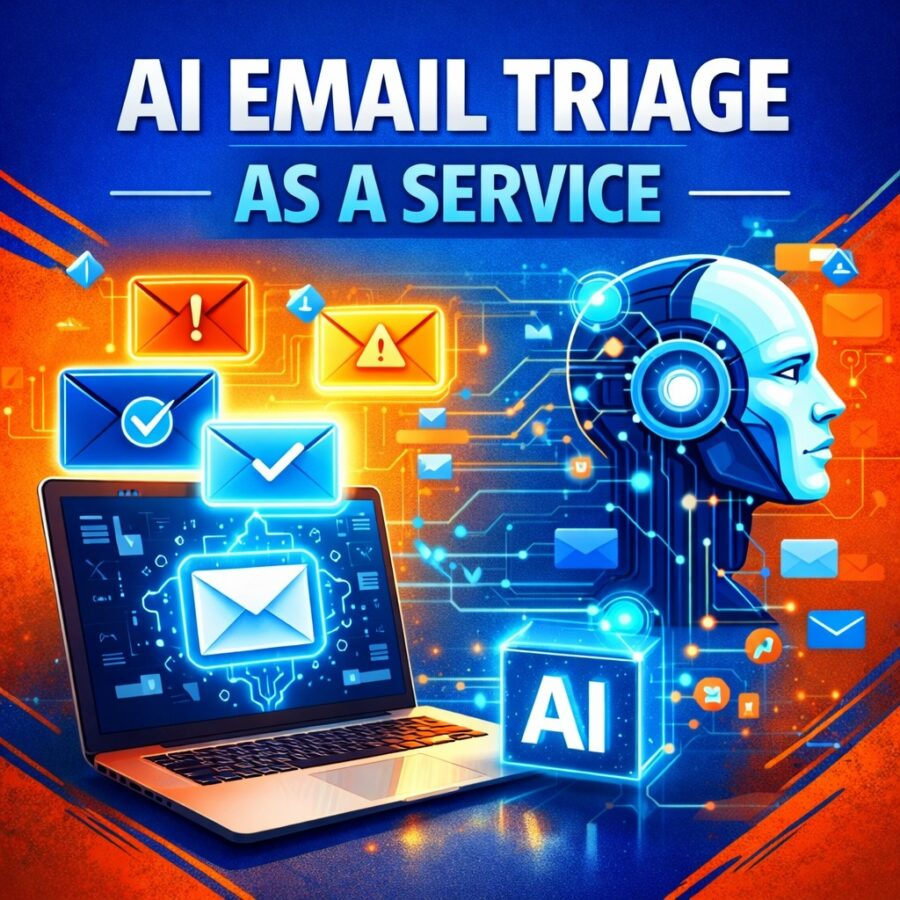
That is why AI Email Triage as a Service is a clean offer. It is practical, fast to deliver, and easy for a client to understand. You are not selling “AI.” You are selling fewer missed leads, fewer late replies, and fewer headaches.
What AI Email Triage as a Service actually means
AI Email Triage as a Service is a setup that does four simple things:
First, it sorts incoming email into clear buckets like Urgent, Sales, Billing, Scheduling, Vendors, and Receipts.
Second, it flags risky or suspicious messages so staff slow down before clicking anything.
Third, it creates short summaries and reply drafts for common questions, without sending anything automatically.
Fourth, it produces a daily or twice-daily “what needs attention” digest so the owner can focus fast.
This is not a robot that runs the business. It is a calm traffic cop for the inbox.
Why this sells right now
People spend a shocking amount of time in email. McKinsey has long estimated that “interaction workers” can spend about 28% of the workweek managing email. (McKinsey & Company) Harvard Business Review echoes the same core idea and frames it as roughly 2.6 hours a day for many professionals. (Harvard Business Review)
Now stack that time cost on top of constant interruptions. Microsoft’s Work Trend Index reporting on Microsoft 365 telemetry says employees are interrupted every two minutes on average by meetings, emails, or notifications, and it cites 275 interruptions a day during the workday pattern they studied. (Microsoft)
For a small business, interruptions are not just annoying. They are expensive. They break focus, slow down service, and push responses into “later,” which is where leads go to die.
The “48-hour” promise that makes this offer irresistible
Small business owners do not want a six-week project plan. They want relief by Wednesday.
You can deliver AI Email Triage as a Service in 48 hours because you are not building custom software. You are installing a sensible system using tools they already have, plus a lightweight AI layer that helps summarize and draft.
Your promise should sound like this:
“In two days, your inbox will sort itself, highlight urgent messages, draft replies for the common stuff, and send you a daily digest of what matters.”
That is a real outcome, and it is easy to verify.
What you deliver, in plain language
Here is the core deliverable list for AI Email Triage as a Service:
A labeled inbox
You create categories that match how the business actually runs. Examples:
- Urgent today
- New lead
- Customer support
- Billing and invoices
- Scheduling
- Vendors
- Internal team
- Receipts and statements
- Newsletters and promos
Rules that sort automatically
These rules tag and route email based on sender, keywords, and simple patterns. Nothing fancy. Just reliable.
A short reply library
You build 10 to 25 reusable replies that cover the repeat questions. Polite. Clear. On brand.
Draft replies, not auto-send
AI suggests drafts for review. A human clicks send. This keeps trust high.
A daily digest
One message that says: “Here are the 7 emails that need a human today,” with short summaries.
A safety lane
Anything that smells like phishing, payment fraud, or weird link behavior gets flagged for caution. CISA’s guidance on phishing is straightforward: phishing tries to trick people into opening harmful links, emails, or attachments to steal information or infect devices. (CISA)
Affiliate Link
See our Affiliate Disclosure page for more details on what affiliate links do for our website.

A quick word about security and why you should mention it
Email is a favorite path for attackers because humans are busy.
Verizon’s 2025 DBIR Executive Summary says the “human element” is involved in around 60% of breaches, and it also notes ransomware is disproportionately affecting SMBs in their dataset. That does not mean your triage service is “cybersecurity.” It means your service should include basic protective habits, because the inbox is where trouble often starts.
A good triage setup reduces risk by slowing people down on suspicious messages and making it easier to spot “weird” patterns.
The 48-hour implementation plan
This is the part that makes you money. It is your repeatable process.
Day 1 (2 to 4 hours): intake and mapping
Step 1: Get access the right way
Use delegated access or shared inbox access if possible. Avoid asking for the owner’s main password. Keep it clean and auditable.
Step 2: Identify the business “email paths”
Ask simple questions:
- Where do leads come from?
- Who answers customer questions?
- What counts as urgent?
- What invoices must never be missed?
- What is safe to archive immediately?
Step 3: Pull 30 days of patterns
You are looking for repeat senders, repeat subjects, repeat words. This becomes your rules list and your reply templates.
Step 4: Define the categories
Do not overbuild. Most businesses do well with 8 to 12 categories.
Day 2 (2 to 4 hours): build, test, and launch
Step 1: Create labels or folders and routing rules
Gmail labels, Outlook folders, shared inboxes. Whatever they use, your structure stays the same.
Step 2: Build the reply library
Create short, friendly answers for the most common questions. Add placeholders so staff can personalize quickly.
Step 3: Turn on AI drafting in a controlled way
If you are using an AI feature inside Google Workspace or Microsoft 365, make sure the client understands how data is handled.
Google’s Workspace admin privacy guidance for Gemini states that interactions stay within the organization, existing Workspace protections apply, and customer content is not used for model training outside the domain without permission. (Google Help)
That is the kind of language that makes owners breathe again.
Step 4: Test with real scenarios
Run 20 test emails through the system. Confirm:
- Correct category
- Clear summary
- Safe draft that does not invent facts
- Obvious handoff when the AI is unsure
Step 5: Train in 20 minutes
Show the owner and staff how to use it:
- Where to look first
- How to approve drafts
- What to do with flagged messages
- How to request a new template
Affiliate Link
See our Affiliate Disclosure page for more details on what affiliate links do for our website.

The pricing that makes sense for small businesses
AI Email Triage as a Service should be priced like a setup plus ongoing care. The setup is the build. The monthly is the tuning and support.
Starter (most common)
- Setup: $450 to $950
- Monthly: $79 to $199
Best for: solo owners, small teams, service shops
Growth
- Setup: $950 to $1,750
- Monthly: $199 to $399
Adds: shared inbox workflow, lead capture tags, weekly digest reporting, more templates
Pro
- Setup: $1,750 to $3,500
- Monthly: $399 to $900
Adds: multi-inbox triage, role-based routing, monthly review call, deeper safety controls
The owner is not paying for “AI.” They are paying for speed, fewer misses, and calmer operations.
How to pitch it without sounding like a tech brochure
Walk in with one sentence:
“I can make your inbox sort itself and draft replies, so you stop losing leads and stop answering the same questions every day.”
Then say what you do not do:
- “Nothing auto-sends without your approval.”
- “If the system is unsure, it asks for a human.”
- “We flag suspicious emails so your team slows down.”
That simple framing beats any fancy demo.
The deliverables you put in the proposal
Keep the scope tight. A tight scope is how you deliver in 48 hours.
Include:
- Categories and rules setup
- 10 to 25 reply templates
- AI drafting enabled with approval workflow
- Daily digest setup
- Safety flagging guidelines
- One week of tweaks included
- Optional monthly tuning plan
If the client wants more, you upsell after the first win.
The metrics that prove it works
Small businesses love proof when it is simple.
Track these:
- Average response time to new leads
- Number of missed invoices or late payments (should drop)
- Time to “inbox zero” each day
- Number of common questions handled with templates
- Count of suspicious emails flagged and reviewed
When the owner feels the difference, the renewal is easy.
Common objections and smart answers
“Will it read my private emails?”
Answer: “We only set up rules and templates for business categories. We can also exclude personal folders or accounts.”
“What if the AI says something wrong?”
Answer: “It drafts only. A person approves. We also lock templates for sensitive topics like refunds, legal issues, and pricing exceptions.”
“Is this safe?”
Answer: “We keep approvals human, we flag suspicious messages, and we follow your platform’s privacy controls. We can also limit AI use to summaries only.”
The bottom line
AI Email Triage as a Service is a small business offer with a rare combo: it is easy to explain, quick to install, and instantly felt by the customer.
Email volume is not slowing down, and interruptions are not going away. (radicati.com) Small business owners do not need more apps. They need fewer missed moments.
Give them a calmer inbox in 48 hours, and you will have a service they keep paying for.