Views: 0
Some of the best ideas arrive in the worst packaging.
They show up as half sentences, voice memos, sticky notes, or a bullet list you wrote while waiting in a parking lot. The problem is not the thinking. The problem is translation. You have to turn rough material into copy that reads like a human meant it.
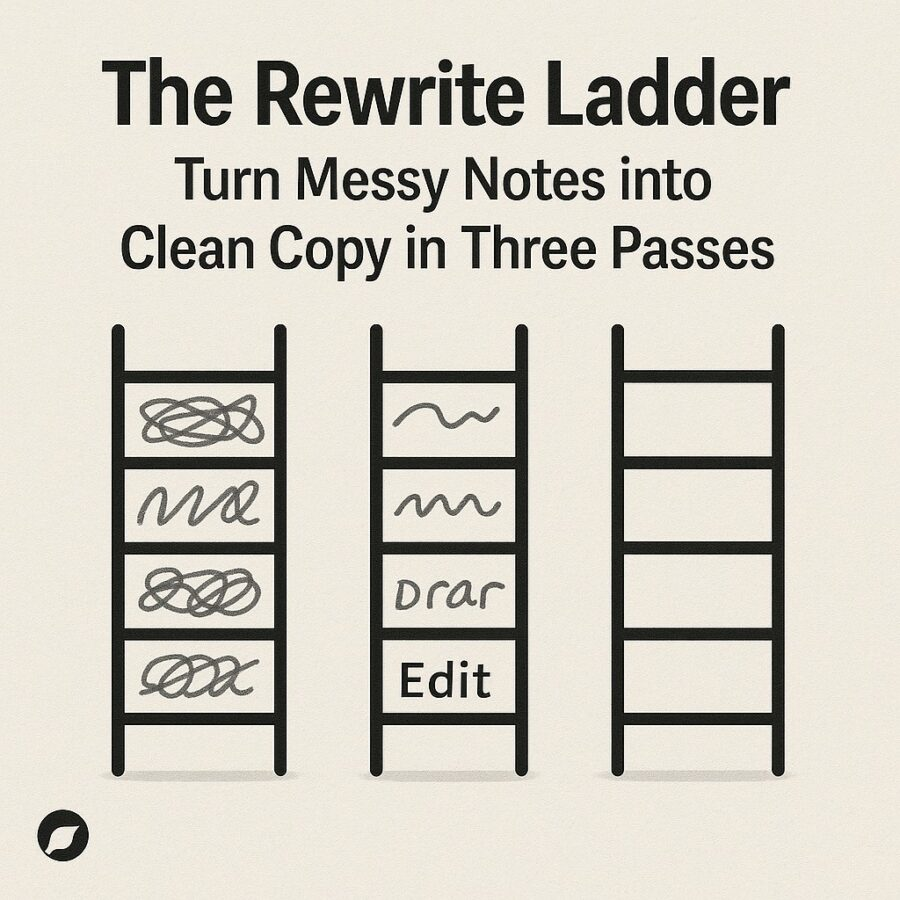
The Rewrite Ladder: Turn Messy Notes into Clean Copy in Three Passes is a simple method for that translation. It is not “write harder.” It is “rewrite smarter.” You move through three passes, each with a narrow goal. That single choice keeps you from editing everything at once, which is how people get stuck.
There is also a practical reason this works online. Readers usually scan web pages first, then decide what deserves attention. Clear headings, short paragraphs, and direct wording help them stay oriented. (Nielsen Norman Group)
The ladder mindset
A ladder is useful because it gives you one rung at a time. You do not jump to the roof. You climb.
In writing terms, each pass answers a different question:
- Pass One: What am I saying, and in what order?
- Pass Two: What am I actually claiming, sentence by sentence?
- Pass Three: Does it sound clean, confident, and easy to read?
This echoes what many writing centers teach: drafting, revising, and editing are distinct moves, even if they overlap in real life. (Harvard Library Guides)
Before you start, do one minute of setup
Messy notes feel messy because they mix ingredients. Separate them briefly:
- Facts: numbers, dates, definitions, quotes
- Ideas: arguments, angles, themes
- Actions: what the reader should do next
- Stories: examples, personal moments, mini scenes
You are not “organizing for fun.” You are preventing confusion later.
A running example: the messy notes
Here is a realistic set of notes for a creator writing a blog post about repurposing content:
- “Creators waste time rewriting same idea.”
- “Make 1 pillar post, slice into 6 shorts, 1 email.”
- “Need a system. AI helps but can get fluffy.”
- “Checklist at end.”
- “Mention scanning, readers skim.”
- “Include example workflow.”
- “Don’t overpromise. Show steps.”
These notes have value, but they do not yet have shape. The Rewrite Ladder fixes that in three passes.
Pass One: Shape and sequence
Pass One is structural. You are deciding what belongs and what does not. You are also deciding the order that will make sense to a tired reader.
Purdue OWL puts it plainly: revision starts by checking your main point, purpose, and evidence, then tightening what stays. (Purdue OWL)
Pass One goal
Create a clear spine for the piece: promise, sections, and flow.
Tools for Pass One
1) The one sentence promise
Write one sentence that tells the reader what they get.
Example promise from the notes above:
“You will learn a repeatable way to turn one solid post into multiple pieces of content without rewriting from scratch.”
If you cannot write this sentence, you are not ready to draft.
2) A reverse outline, even before you write
A reverse outline is usually done after a draft, but you can use the same logic with notes. You list the main point of each chunk, then test the order.
UNC’s Writing Center describes reverse outlining as a way to evaluate organization and argument by outlining what you actually have, not what you wish you had. (The Writing Center)
For our notes, a quick reverse outline might look like this:
- Problem: creators rewrite too much
- Principle: readers skim, so clarity matters
- System: pillar post to slices
- AI role: speed, but risk of fluff
- Example workflow
- Checklist
Now you have a draft map.
3) Section questions
Turn each section into a question a reader would type.
- Why does rewriting waste so much time?
- What system prevents it?
- How do I repurpose without sounding repetitive?
- Where does AI help, and where does it hurt?
- What does an example look like?
- What checklist can I use today?
Questions keep your writing honest.
Pass One prompt for ChatGPT
Prompt: I have messy notes for a blog post. Turn them into a clean structure.
Inputs:
- Working title: [PASTE TITLE]
- Notes: [PASTE NOTES]
Requirements:
- Write a one sentence promise.
- Create an outline with 6 to 9 H2 headings and optional H3 subheadings.
- Each H2 must be phrased as a question the reader cares about.
- Add one sentence under each H2 explaining what the reader will learn.
Rules: plain English, no hype, no invented facts.
Pass One checkpoint
You pass when you can read only the headings, in order, and the logic feels inevitable.
If the order feels jumpy, fix it now. Structure is cheap to change at this stage.
Pass Two: Clarity and claims
Pass Two is where you turn “idea fog” into sentences that carry meaning. Most people try to do this while also polishing style. That slows them down.
In this pass, you focus on three things:
- Each paragraph has one job.
- Each job supports the promise.
- Each claim is either supported, softened, or removed.
This aligns with standard revision advice: check whether the body supports the thesis, whether evidence is sufficient, and whether ideas are clear. (Purdue OWL)
Pass Two goal
Write clean paragraphs that say what you mean, without fog.
The paragraph recipe that keeps you moving
A practical paragraph pattern:
- Point (what you claim)
- Proof (example, detail, or reasoning)
- Push (what the reader should do with it)
Example, built from our notes:
- Point: “Most creators lose time because they treat every post like a fresh start.”
- Proof: “They rewrite the same explanation for every platform, even though the core idea stays the same.”
- Push: “Instead, build one pillar piece, then repurpose it with a consistent template.”
That is clear. It is also easy to expand.
A rule for trustworthy writing
If you cannot support a factual statement, do not present it as a fact. Mark it and come back with a source, or phrase it as an observation.
This matters because AI can sound certain even when it is guessing. Your job is to keep certainty attached to truth.
Pass Two prompt for ChatGPT
Prompt: Help me draft the body of this article using the outline below.
- Outline: [PASTE OUTLINE]
Rules: - Write short paragraphs, 1 to 3 sentences each.
- Every H2 must include: a clear point, a practical example, and a simple step the reader can take.
- If a claim needs a source, write [SOURCE NEEDED] instead of guessing.
- Keep the tone: calm male college professor, helpful and direct.
Output: the full draft only.
Pass Two checkpoint
Pick three random paragraphs. For each one, answer:
- What is the point?
- What is the example?
- What should the reader do?
If you cannot answer in ten seconds, rewrite that paragraph.
Pass Three: Readability and polish
Pass Three is not where you rewrite the whole piece again. It is where you make the piece easy to read.
Yoast’s readability analysis focuses on signals like transition words, passive voice, and sentence and paragraph length, because those features often correlate with smoother reading. (Yoast)
Nielsen Norman Group’s research also supports a simple truth: web content performs better when it is concise, scannable, and objective, because many users scan first. (Nielsen Norman Group)
Pass Three goal
Make the draft feel effortless.
Pass Three edits that pay off fast
1) Add transition words where logic needs a bridge
Words like “however,” “because,” “therefore,” and “for example” help the reader follow the chain of reasoning. (Yoast)
2) Shorten long sentences
If a sentence has three ideas, split it. Your reader will thank you.
3) Reduce passive voice when it makes sentences heavy
Passive voice is not evil, but it can feel distant and wordy. Yoast notes that passive voice can increase cognitive effort for readers. (Yoast)
4) Break up dense sections
Use bullets, small subheads, or a short example block.
5) Tighten vague phrases
Replace “a lot” with a number when possible. Replace “things” with a real noun. Replace “very” with a stronger verb.
Pass Three prompt for ChatGPT
Prompt: Edit this draft for readability and clean style.
Draft: [PASTE DRAFT]
Checklist:
- Add transition words where needed.
- Cut repeated ideas.
- Reduce passive voice when it hurts clarity.
- Shorten long sentences.
- Improve headings for scanning.
- Keep the tone steady: educated, friendly, and plain-spoken.
Deliverables:
- Edited draft.
- A list of the 12 most important edits you made, with short reasons.
Pass Three checkpoint
Read the first two paragraphs out loud. If you stumble, simplify the sentence.
Then skim the headings only. If the headings tell the story, you are close to done.
Putting the three passes together on the example
Let’s apply the ladder to our messy notes quickly, so you can see the transformation.
After Pass One
You get a clear map:
- Why rewriting wastes time
- How scanning changes writing choices
- The pillar and slice system
- Where AI helps and where it bloats
- A step-by-step example
- A checklist
After Pass Two
You get paragraphs that are specific:
- A definition of “pillar content”
- A repurposing sequence
- A warning about AI fluff
- A concrete workflow that a reader can copy
After Pass Three
You get writing that is easy on the eyes:
- Shorter sentences
- Better transitions
- Cleaner headings
- Fewer weak phrases
- A stronger opening that states the promise
That is the point of The Rewrite Ladder: Turn Messy Notes into Clean Copy in Three Passes. You do not rely on mood. You rely on method.
A fast checklist you can keep beside your keyboard
Pass One: Shape
- I can state the promise in one sentence.
- Each heading answers a reader question.
- The order flows without detours.
Pass Two: Clarity
- Each paragraph makes one clear point.
- Examples are concrete, not abstract.
- Claims are supported or labeled.
Pass Three: Polish
- Paragraphs are short.
- Transitions guide the reader.
- Sentences do not sprawl.
- Headings are scannable.
Yoast’s readability guidance is helpful here because it nudges you toward these exact habits. (Yoast)
How creators can use this to earn faster
If you use content to make income, the ladder gives you a production advantage without lowering quality.
Three practical uses:
- Client work: Turn call notes into clean blog posts, landing pages, or newsletters quickly.
- Batch writing: Draft three posts from messy idea dumps, then polish them in one editing session.
- Repurposing: Convert one long post into platform-specific versions without rewriting from scratch.
The important part is restraint. AI can speed up each pass, but you still decide what is true, what is useful, and what should be cut.
A clean stopping point
Many writers fail to finish because they never declare the work “done.”
Here is a good stopping rule: if the post delivers on its promise, reads smoothly, and does not overclaim, publish it. Then improve the next one.
Rewriting is the heart of strong writing. The ladder just makes that process practical, repeatable, and fast. (The Writing Center)