Views: 4
Your average small business does not have an onboarding “system.” It has a calendar invite, a stack of sticky notes, and one heroic employee who answers the same questions 40 times a week.
That chaos is expensive. New hires feel lost, managers get interrupted, and the company’s standards get explained differently depending on who is tired that day.
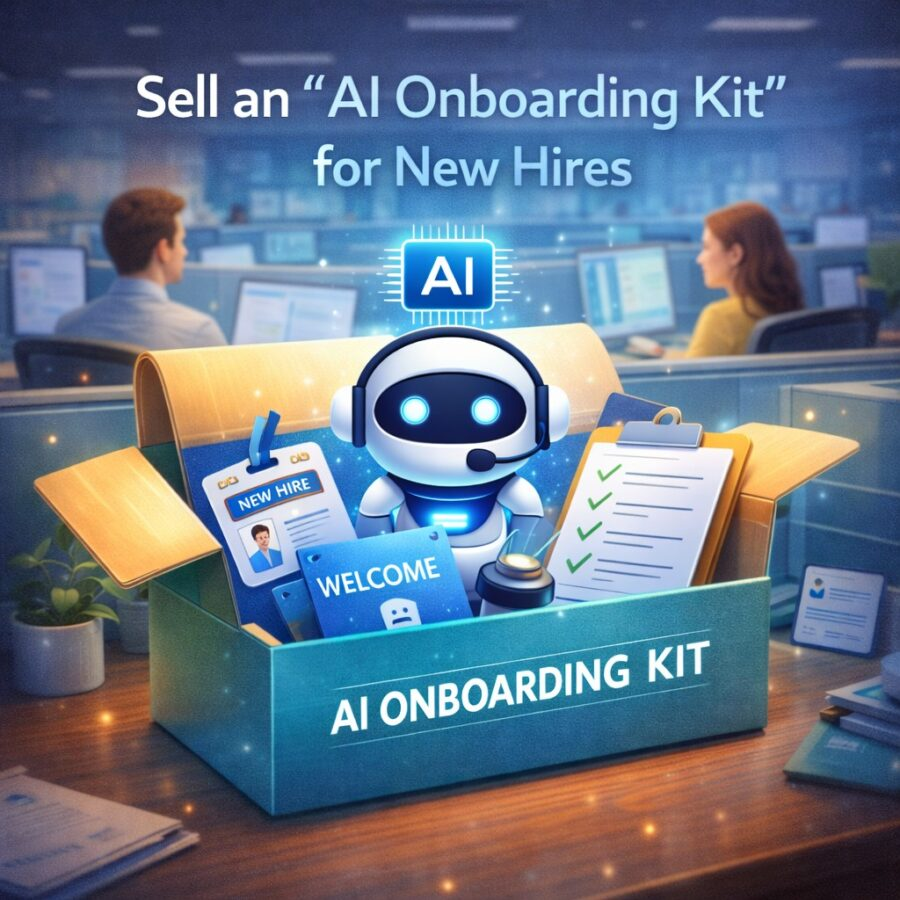
That is exactly why you can sell an AI Onboarding Kit to new hire heavy businesses. Not a vague “AI solution.” A practical kit that makes Day 1 through Day 30 feel organized, repeatable, and human.
And the timing is perfect. Gallup has reported that only a small slice of employees strongly agree their organization does onboarding well, which means the bar is low and the opportunity is high. (Gallup.com)
What an AI Onboarding Kit for New Hires really is
An AI Onboarding Kit for New Hires is a packaged set of ready to use onboarding assets that a business can copy, customize, and run every time they hire someone.
It is not software. It is not a giant HR platform. It is a done for you toolkit that includes:
- Manager scripts for key conversations
- New hire checklists that prevent missed steps
- Training plans that reduce “shadowing roulette”
- AI assisted templates that adapt the materials per role
- Clear rules for using AI at work without leaking sensitive data
The value is simple: you take onboarding out of people’s heads and put it into a repeatable system.
SHRM frames onboarding as more than orientation, with steps like preboarding, orientation, foundation building, and support systems like mentoring or buddy programs. Your kit turns those concepts into actual documents and workflows. (SHRM)
Why businesses will pay for this now
A modern company has two problems at once.
First, they need consistent onboarding because churn is brutal and time to productivity matters.
Second, they are being pushed into AI whether they feel “ready” or not. Microsoft’s Work Trend Index reporting shows a training gap: many people use AI at work, but far fewer have received training, and fewer companies plan to offer it. That gap creates confusion, uneven quality, and avoidable risk. (Microsoft)
So when you sell an AI Onboarding Kit, you are really selling clarity.
You are selling fewer interruptions for managers, faster ramp for new hires, and a cleaner standard for “how we do work here.”
Affiliate Link
See our Affiliate Disclosure page for more details on what affiliate links do for our website.
Who is the best buyer for “Sell an AI Onboarding Kit”
You will sell fastest to teams that hire frequently and do not have formal HR ops. Think:
- Trades and home services (HVAC, plumbing, electrical, roofing)
- Small medical and dental offices
- Call centers and appointment based businesses
- Local agencies (marketing, web, IT support, bookkeeping)
- Retail and multi location service brands
- Growing startups that just crossed 10 employees
They all share the same pain: “We keep hiring, but onboarding feels different every time.”
Your kit becomes their onboarding backbone.
What goes inside a strong AI Onboarding Kit
When you build an AI Onboarding Kit for New Hires, design it like a meal kit. No one buys it for the recipe ideas. They buy it because it is already portioned and labeled.
Here is a clean structure that sells.
1) The Day Zero preboarding pack
Preboarding reduces first day anxiety and prevents paperwork pileups. Include:
- Welcome email templates (3 versions: warm, formal, remote)
- First day agenda template (hour by hour)
- “What to bring, what to expect” one pager
- Account setup checklist for IT or the owner
- A short “Meet the team” intro script for Slack or email
Make it feel polished. New hires judge competence early.
2) The Day 1 manager scripts
Most onboarding fails because managers wing it.
Give them scripts for:
- The culture and expectations talk
- The “how we communicate” talk
- The performance and feedback talk
- The first week priorities talk
- The “what good looks like here” talk
These scripts should be short enough to use, but specific enough to prevent vague motivational speeches. A manager wants to sound confident without writing a novel.
3) Role based checklists that actually get completed
Checklists are boring until they save someone from embarrassment.
Create three layers:
- Company basics checklist (policies, tools, payroll, security)
- Role checklist (what they must learn, do, and practice)
- Proof checklist (how they demonstrate competence)
Keep items observable. “Understand our process” is fluff. “Complete 3 test tickets using the SOP template” is real.
4) The 7, 14, and 30 day training plan
Your kit should include a ramp schedule that stops the common disaster: dumping everything on the new hire in two days, then disappearing.
Build the training like a series:
- Week 1: fundamentals, tools, simple tasks, daily check ins
- Week 2: core workflows, light production, guided reviews
- Weeks 3 to 4: deeper ownership, quality checks, KPI alignment
This matches what many HR orgs promote: onboarding is a process, not a single event. (Gallup.com)
5) Micro lessons that fit real attention spans
If you want the kit to feel modern, include micro training modules.
Not “watch a 90 minute video.” More like:
- 6 minute video: “How we name files and where they go”
- 4 minute video: “How to respond to a customer complaint”
- 5 minute video: “How to escalate an issue the right way”
Microlearning is popular because it is easier to consume while working, especially on mobile. (eLearning Industry)
6) The AI usage rules, the part nobody wants to write
This is where your kit separates itself from generic onboarding templates.
Include a simple AI policy page:
- Approved tools list
- What data is never allowed (customer data, secrets, contracts, credentials)
- When a human must review outputs
- How to cite sources internally when AI summarizes something
- How to label AI assisted work when appropriate
- A “If you are unsure, do this” escalation rule
If you want an authoritative backbone, NIST’s AI Risk Management Framework emphasizes governance, roles, responsibilities, and oversight. You are not turning a small business into a compliance lab. You are giving them lightweight guardrails that align with mature risk thinking. (NIST)
Affiliate Link
See our Affiliate Disclosure page for more details on what affiliate links do for our website.
The secret weapon: AI assisted personalization without chaos
The phrase sell an AI Onboarding Kit implies AI is doing real work, not just existing in the title.
Here is how you make AI useful without turning the kit into a science project:
- Use AI to tailor role specific training plans from your master template
- Use AI to rewrite scripts in the company’s tone
- Use AI to generate scenario based quizzes for each role
- Use AI to turn SOPs into short “first week cheat sheets”
- Use AI to create a searchable internal FAQ from the kit documents
One clean way to deliver this is to include “prompt cards” with each template, so the buyer can regenerate versions quickly.
Example prompt you can include once inside the kit:
Prompt: You are helping onboard a new hire for the role: [ROLE]. Using the attached company policy and SOP notes, create a 14-day onboarding plan with daily tasks, short learning goals, and a simple end-of-week skills check. Keep it practical, clear, and suitable for a busy small business.
That prompt turns your kit into a living system.
A quick mini case study you can use in your sales page
Imagine a 22 person home services company. They hire two technicians and a dispatcher in the same month.
Before the kit, onboarding looks like this:
- The owner explains things between calls
- The best tech trains the new guy when he is not on site
- The dispatcher asks “Where do I put this?” all day
- Nobody knows what is “correct” because the answer changes by person
After an AI Onboarding Kit for New Hires:
- Day 0 emails go out automatically with the agenda and required forms
- Day 1 manager scripts make expectations consistent
- The dispatcher follows a 7 day ramp plan and completes a skills check
- New techs watch micro lessons, then practice on a sandbox workflow
- AI prompt cards generate role specific refreshers without reinventing anything
- The owner stops being the onboarding help desk
That is what buyers are actually purchasing: reduced friction and fewer fires.
How to package and deliver your AI Onboarding Kit
Make it easy to buy and easy to use. Common delivery formats:
- Google Docs folder with labeled templates
- Notion workspace with a guided dashboard
- A PDF kit plus editable DOCX versions
- Short Loom videos for “how to use this kit”
- Optional add on: customization form and a 60 minute setup call
Structure the folder like a product, not like your personal files.
A clean example:
- 00 Start Here
- 01 Preboarding
- 02 Day 1 Scripts
- 03 Checklists
- 04 Training Plans
- 05 AI Policy and Prompt Cards
- 06 Role Packs (Sales, Support, Ops, Tech)
- 07 Manager Tools (check ins, feedback, reviews)
Affiliate Link
See our Affiliate Disclosure page for more details on what affiliate links do for our website.
Pricing that feels fair and still profitable
You have three smart pricing models when you sell an AI Onboarding Kit:
- Flat price kit (fastest to sell)
- $149 to $499 depending on depth and role packs
- Kit plus customization (best margin)
- $299 kit + $500 to $2,500 customization fee
- Monthly onboarding ops retainer (best long term)
- $250 to $1,000 per month to maintain documents, refresh training, and adjust scripts
Small businesses love a “starter kit” price. They also love paying more once they see it working.
How to market it without sounding like another AI hype guy
Lead with outcomes, not buzzwords.
Use phrases like:
- “Reduce manager interruptions”
- “Make Day 1 consistent”
- “Ramp new hires faster”
- “Stop repeating the same answers”
- “Turn tribal knowledge into a system”
Where to sell:
- Local networking groups and chamber of commerce
- LinkedIn outreach to owners, ops managers, and HR generalists
- Facebook groups for small business owners and trade industries
- Fiverr or productized service sites
- Your blog with one strong lead magnet: a free Day 1 checklist
Your best hook is simple: “Every time you hire, you are rebuilding onboarding from scratch. Here is the kit that stops that.”
Quality and ethics: the promise your kit should make
Your kit should make onboarding more human, not more robotic.
AI should reduce busywork, not replace real conversations. It should help new hires learn faster, not drown them in generated text.
And you should be clear about data boundaries. If a company wants to paste sensitive info into random tools, your kit should discourage that and provide safer habits.
That honesty builds trust, and trust sells.