Views: 0
Picture this.
A client shares a spreadsheet of customers, private notes, and billing data. You promise to “run it through your AI agent” to clean fields, draft emails, and tag leads.
The output looks great.
The real question is what happened to the data.
Did it end up in a model log you cannot see.
In a debug dashboard.
In some third party tool’s training set.
If you want to build real trust with clients, “we care about privacy” is not enough. You need a structure that makes careless data leaks hard, not easy. That is where Privacy By Design: Data Vault Patterns for Client Safe Agents comes in.
This article will walk through how to fuse privacy by design principles, modern data vault ideas, and client side or hybrid AI agents into one pattern you can actually implement.
Why Privacy By Design Matters For AI Agents
Privacy by design is an approach first formalized by Ann Cavoukian in the 1990s. It calls for privacy to be built into systems from the start, not patched on later. Her work defines seven principles, including proactive controls, privacy as the default, and end to end security across the full information life cycle. (Wikipedia)
The idea moved from theory into law with the General Data Protection Regulation in Europe. Article 25 of the GDPR requires “data protection by design and by default” which means you must design systems so that only necessary personal data is processed and so that the default settings protect people, not expose them. (GDPR)
Regulators and researchers repeat the same theme.
- The NIST AI Risk Management Framework encourages teams to embed privacy controls into AI systems from planning through deployment. (NIST)
- The NIST Privacy Framework helps organizations identify and manage privacy risk as they build AI powered products. (NIST)
In other words, if you are serious about client safe agents, you do not ask “how can I add a consent pop up later.” You ask “how can I design the entire flow so that private data is guarded from the first message onward.”
That is exactly what Privacy By Design: Data Vault Patterns for Client Safe Agents is about.
What A Data Vault Pattern Really Means In This Context
In data warehousing, a data vault is a modeling approach that separates core entities, relationships, and descriptive attributes into hubs, links, and satellites. It aims for flexibility and complete history tracking, especially in complex environments. (Databricks)
Privacy engineers have borrowed the term “vault” for a different but related pattern. A data privacy vault is a dedicated, hardened store that isolates sensitive fields from the rest of your systems. It often sits behind a narrow API and handles tokenization, encryption, and fine grained access. (Medium)
For agents, you can combine these ideas into a practical pattern:
Put the most sensitive client data into a special vault layer. Give your agents controlled access to that vault instead of raw access to every file and table.
When you design around this idea, you reduce the blast radius of a mistake, a bug, or a prompt injection. It becomes much harder for an agent to spray secrets into logs, plugins, or external tools.
Core Ideas Behind A Privacy Data Vault For Agents
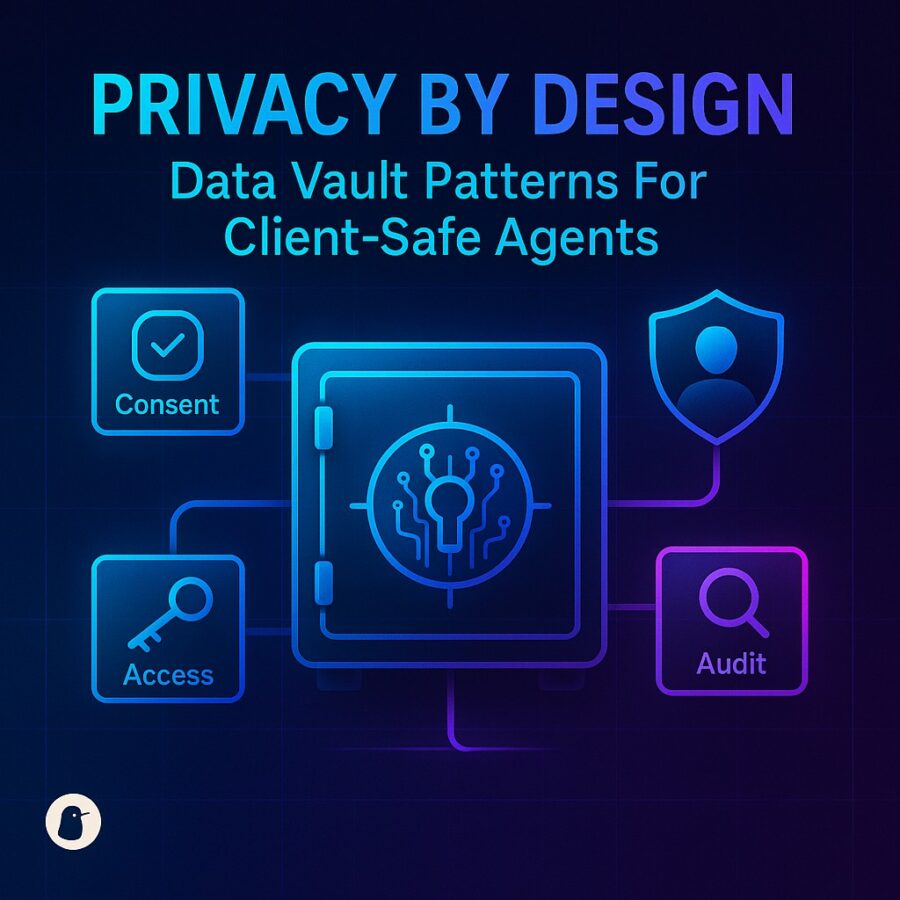
To make Privacy By Design: Data Vault Patterns for Client Safe Agents concrete, imagine a vault with these traits:
- Isolation
Sensitive fields such as names, phone numbers, payment details, and medical notes live in a separate store, database schema, or encrypted file set. Only specific services can touch them. - Tokenization and indirection
The broader system sees tokens or surrogate keys rather than raw values. The agent mostly works with tokens, metadata, and derived attributes, not full cleartext records. (Medium) - Minimum interfaces
You provide just a handful of vault operations like “lookup client by token”, “get redacted profile”, or “store consent update”. No generic SQL access. No “SELECT *” from inside the agent tools. - Strong cryptography
Data inside the vault is encrypted at rest with managed keys and encrypted in transit. Key material is not visible to the agent runtime. - Lifecycle control
The vault tracks when records were created, why they exist, and when they should be deleted or masked. This supports legal retention rules. - Full audit trail
Every call to the vault is logged with who, what, when, and why. This improves accountability and makes incident response easier.
Think of the vault as a bouncer at the door between sensitive client data and everything else your agents might do.
What Makes An Agent “Client Safe”
A client safe agent is not just smart. It is well behaved with private data by design.
That means it should:
- Only see what it needs for a given task.
- Keep data local to the client’s device when possible.
- Avoid storing long term copies in places that are hard to inspect.
- Be hardened against attacks that try to trick it into exposing secrets.
Modern guidance backs this direction. Client side AI approaches highlight the benefit that user data stays in the browser or app, instead of being shipped to a remote server for every task. (Grid Dynamics)
At the same time, security groups like OWASP warn that large language model agents bring new risks, including prompt injection, sensitive information disclosure, and insecure plugin design. (OWASP Foundation) Prompt injection attacks try to hide malicious instructions in user input or web content to make the model break its own rules and leak secrets. (Wikipedia)
If you want Privacy By Design: Data Vault Patterns for Client Safe Agents to hold up, your design must assume those attacks will happen and still keep client data safe.
The Privacy By Design: Data Vault Patterns For Client Safe Agents Blueprint
Now let us turn the ideas into a step by step blueprint you can apply to your own tools, products, or workflows.
Step 1: Map Data Flows And Classify Information
Start by drawing how information moves.
- Where does client data enter: uploads, forms, email imports, APIs.
- Where does it travel: vector stores, logs, caches, agent memory, third party services.
- Where does it rest: databases, cloud storage, local files.
Then classify fields into groups like:
- Public or low risk
- Internal but not sensitive
- Personal or confidential
- Highly sensitive such as health, finance, or legal notes
You can borrow concepts from privacy frameworks that talk about mapping processing activities and identifying privacy risks in context. (NIST)
Once you know what is truly sensitive, you can decide what belongs in the vault.
Step 2: Draw A Firm Vault Boundary
Choose where your vault will live. It might be:
- An encrypted database table with strict access control
- A dedicated key vault or tokenization service
- A local encrypted store on the client’s device
The key is that only a small, well reviewed part of your system can call vault operations. Agents and tools never talk directly to the underlying storage. They call higher level functions like “get anonymized customer list for segmenting” or “fetch contact details for this single client with explicit consent”.
Data vault style architectures show that separating core entities, relationships, and descriptive data into structured layers can help with both governance and security. The same idea applies here. (Databricks)
Step 3: Design Vault Aware Prompts And Tools
Your agent should know it is working with a vault, even if it never sees raw secrets.
You can:
- Build tools that return masked or partial views by default, such as names with initials only or ranges for income instead of exact numbers.
- Include instructions in system prompts that tell the model how to request data through those tools, and when not to ask for more detail.
- Make “privacy as the default” the actual behavior of your tools, not just a slogan. (CES Privacy)
If a model tries to pull entire tables, your tools should simply not support that call.
Step 4: Limit Memory And Logs
Client safe agents should be forgetful by default. That sounds odd at first, but it matches privacy by design principles.
Practical moves:
- Use short context windows for sensitive tasks and avoid reusing conversations with different clients.
- Turn off verbose logging for prompts that contain private data, or scrub logs before storage.
- Store long term summaries that remove details and keep only what you truly need.
This matches the GDPR idea that systems should only process data necessary for a specific purpose and should avoid making data broadly accessible. (GDPR)
Step 5: Build For Threats, Not Just Happy Paths
If you deploy agents in real environments, hostile prompts and weird edge cases are inevitable.
To keep Privacy By Design: Data Vault Patterns for Client Safe Agents robust, run security checks that focus on:
- Prompt injection tests that try to trick the agent into dumping vault contents. (Wikipedia)
- Insecure output handling, where the agent might generate code or queries that exfiltrate data when executed. (Cloudflare)
- Excessive agency, where the agent chains tools in ways you did not intend. (Cloudflare)
Use the OWASP Top 10 for LLM applications as a checklist and design specific guardrails for each category of risk. (OWASP Foundation)
Three Concrete Data Vault Patterns For Client Safe Agents
Here are three patterns you can adapt whether you are a solo builder, a small agency, or part of a tech team.
Pattern 1: Local First Vault For Freelancers And Solo Pros
Ideal for consultants and creators working with client files on their own laptop.
- Store sensitive client data in an encrypted local database or password manager style store.
- Run your main agent either in the browser with client side AI libraries or via a desktop app that keeps raw data on device. (Grid Dynamics)
- Only send anonymized or aggregated snippets to cloud models.
This pattern fits small shops that do not want to operate server infrastructure but still want Privacy By Design: Data Vault Patterns for Client Safe Agents to guide their work.
Pattern 2: Hybrid Vault For Agencies And Small Platforms
Useful when you run a web app or shared workspace for clients.
- Maintain a central vault in your backend for sensitive fields, with strong encryption and fine grained access controls. (Medium)
- Keep derived data, metrics, and anonymized embeddings in separate stores that the agent can use freely.
- Have client side components handle the most sensitive operations, such as reading local files, before sending sanitized data to the server. (Grid Dynamics)
Here, your data vault pattern gives you a clean story for audits and client questions while still allowing powerful shared agents.
Pattern 3: Managed Vault Service Integrated With Your Agent Layer
This is a better fit for startups or larger products.
- Use or build a dedicated privacy vault service that tokenizes sensitive data and exposes a narrow REST or gRPC API. (Medium)
- Treat your agent orchestration layer as a separate client of that service.
- Apply NIST style privacy risk management across both layers so you do not lose sight of where risks concentrate. (NIST)
The clear separation makes it easier to evolve models and agent workflows without constantly touching the most sensitive code.
Anchoring Your Design In Real Standards
A big advantage of Privacy By Design: Data Vault Patterns for Client Safe Agents is that it aligns naturally with existing standards.
- GDPR Article 25 talks about data protection by design and by default, where you choose techniques that support data minimization, pseudonymization, and restriction of access from the earliest stages of design. (GDPR)
- NIST Privacy Framework 1.1 aims to help organizations using AI identify privacy risks and match them with controls and governance practices. (NIST)
- NIST AI RMF supports building trustworthy AI by managing privacy, security, and safety risks through the system life cycle. (NIST)
- OWASP GenAI and LLM Top 10 give a focused view on security risks like prompt injection, sensitive information disclosure, and insecure plugin design in AI agents. (OWASP Foundation)
This means your vault and agent design does not float in a vacuum. You can map each part of your architecture to sections in these frameworks and show clients that your “privacy by design” claim has real structure behind it.
What This Means For Your Work And Your Clients
You do not need a legal department or a huge engineering team to benefit from Privacy By Design: Data Vault Patterns for Client Safe Agents.
Here is what it means in practice:
- You can explain to clients where their data lives, which parts are tokenized, and how long you keep records.
- You can describe clearly which agent tools can see raw information and which cannot.
- You can show logs that prove you handle access in a disciplined way.
Most of all, you move from “trust me” to “here is how the system protects you, even if I make a mistake.”
In a world where many people do not understand how AI tools handle data, that clarity becomes a competitive edge.
A Starter Checklist You Can Apply Today
To close out Privacy By Design: Data Vault Patterns for Client Safe Agents, here is a simple checklist you can turn into action this week:
- Inventory one workflow
Pick a single agent powered process, such as “summarize client reports” or “draft outreach emails.” Map all the places where data flows or rests. - Tag sensitive fields
Mark the fields that count as personal, financial, health, or legal. Decide which ones belong in a vault. - Introduce a minimal vault layer
Move those fields into a separate store or encrypted file. Wrap that store with a tiny API rather than letting agents touch it directly. - Adjust prompts and tools
Update your tools so they return masked or aggregated data by default. Add system instructions that discourage unnecessary data pulls. - Tighten logs and retention
Turn down logging for sensitive prompts and set time based rules for deleting old runs and caches.
Small moves like these will already put you ahead of many teams that treat privacy as an afterthought.
You can scale up from there, adding more refined data vault structures, client side processing, and risk driven controls over time.
Your clients will not see every detail, but they will feel the difference when you can speak about privacy with confidence, show your design, and keep their trust while your agents work on their most important data.